Should people avoid whole-body screening info?


Astral Codex Ten
Subscribe Sign in
Should People Avoid Whole-Body Screening Info?
...


Jun 23, 2026
155
176
9
Share
The most controversial part of last week’s article on the Midjourney ultrasound scanner was medical experts’ recommendation against whole-body screening (including existing whole-body screening technology using MRI).
Isn’t this crazy? Whole-body screening can save lives by detecting serious diseases like cancer. The experts counterargue that it finds so many false positives - minor zit-like imperfections that would never have caused problems, but which cost patients time, money, anxiety, and side effect burden to investigate - that it ends up net negative. But isn’t this just a problem of setting thresholds correctly? Can’t you commit to only investigating the most obviously bad things, then ignore the rest?
 This seemed like an interesting problem to investigate in more depth, so I’ve tried to get numbers. These are rough estimates loosely based on parameters extracted from unsatisfactory studies1 - please don’t take them seriously as exact values, just as right-order-of-magnitude estimates. We’ll focus on whole-body MRIs, since this is a well-studied existing technology, then speculate later on how the results might generalize to whole-body ultrasound.


For every 1,000 seemingly-healthy people who get whole-body screening MRIs:
- **680** look fine and no follow-up is needed.
- **300** have mildly concerning findings. They’re told to follow-up with specialists, get further tests, or come back for more imaging later.
- **20** have extremely concerning findings and get immediate biopsies (surgeries to collect tissue samples from the area).
- Of those 20 people who got biopsies, **10** turn out to really have some serious disease. This is usually cancer, and for simplicity we’ll focus entirely on cancer going forward.
- Of those 10 cancer patients, **4** end up living longer and healthier lives because their cancer was detected early. The other six either have such slow-growing cancers that they would never have noticed before dying of something else, or such deadly cancers that detecting them early doesn’t help, or would have been found by standard screening so soon afterward that the extra screening didn’t buy meaningfully more time.
- Meanwhile, the 300 people who followed up with specialists and got extra tests will spend some number of years seeing more doctors and getting more tests and waiting and seeing, and eventually for **4** of them this will result in detecting some dangerous condition in a way that causes them to live longer and healthier lives.
So in total, 8 of the 1,000 people have benefited. The average benefit among those 8 people is 4 quality-adjusted life-years, so the total benefit from the scans is ~32 QALYs.
What’s the total cost?
- The original 1,000 scans cost about $2K each, and each takes about 3 hours of patient time (one hour for the scan itself, but we add two hours for driving, waiting, arranging the appointment, etc).
- The 300 patients who follow up each cost about another $2K in extra scans, tests, and doctor visits, and let’s say this takes them each ten hours (probably over the course of several years; some of what they’re doing is waiting and seeing whether the anomaly gets bigger vs. goes away). Rare and minor side effects of the testing might contribute -0.005 QALYS per person.
- Additionally, these people are anxious. 29% of them report “moderate” or “severe” distress. It’s easy to trivialize this and round it off to meaningless, but it’s doesn’t feel trivial when it’s happening to you or a loved one. In my day job as a psychiatrist, I sometimes encounter patients having mental breakdowns (the polite term is “adjustment disorder”) over potential cancers that they’ll have to wait six months to retest. The literature quantifies this as an average cost of 0.01 QALYs per uncertain test result.
- The 20 biopsies each cost about $5K and take about 10 hours. Biopsies are pretty minor as surgeries go, but there’s always some risk of post-surgical complication, and in the end these probably cost 0.04 QALYs each. Add the extra 0.01 for anxiety, and it’s a total of 0.05.
- We’ll very optimistically assume that there’s no extra cost to being diagnosed with a cancer that doesn’t require extra early treatment. The doctor says “You have cancer, but it’s a very slow cancer that will take thirty years to harm you, and you’re eighty years old, so this doesn’t matter. Just be chill.” This doesn’t always work in real life, but we’re trying to imagine a best-case scenario.
- We’ll very optimistically assume that after enough tests, the smartest doctors can distinguish cancers that should be treated and cancers that shouldn’t be treated with 100% accuracy, or at least that the number of cancers caught according to the above statistics is at some threshold where falsely identifying a cancer as treatable is rare.
- We’ll assume that the extra cost of treating the treatable cancers is zero. Why assume this? Because if we didn’t detect the cancer early, we would have detected it later, and still had to treat it, and the cost of treating small early cancers is probably no worse - and likely better - than the cost of treating large late cancers (even though treating the latter is less likely to work). So zero is actually close to an upper bound!
So total costs are $2.7 million, 6,200 hours of patient time, and 5 QALYs.
``` 32 QALYS ←→ $2.7 million + 6,200 hours + 5 QALYS 27 QALYS ←→ $2.7 million + 6,200 hours 25 QALYs ←→ $2.7 million $108,000 per QALY ```
So, converting everything to the same units, whole-body screening costs $108,000 to save one quality-adjusted life year. Usually in health economics, $100,000 per year of healthy life saved is considered the bar for a good cost-effective intervention (though other sources say $150,000). So this is somewhere around the bar, not unambiguously good or bad.
**Could we improve this number by refusing to follow up on ambiguous results?**
I think these numbers assume that we’re already being pretty rational in ordering followup. We’re following up on the 300 cases with minor findings because that genuinely discovers 4 extra cancers, in a way that’s more cost-effective than the original round of screening. If doctors irrationally followed up on truly minor results, then that would make the cost-benefit ratio worse.
**What if you’re personally rich and $2,000 means nothing to you?**
In this situation, wouldn’t the benefits obviously outweigh the costs? The majority of the costs in the analysis above were financial, but this hypothetical rich person can ignore them.
This should be surprising, since every statement I’ve seen about the costs of whole-body screening downplays the financial angle and says that disadvantage is in anxiety, follow-up, and side effects from additional testing. Let’s double-check it.
This individual is buying a 1/125 chance of gaining 4 QALYs (=0.03 QALYs in expectation) at a cost of $0 (money is meaningless to him!), 3 hours of his time, plus a 1/3 chance of -0.015 QALYs of anxiety and testing side effects and 10 additional hours of medical appointments, plus a 1/50 chance of -0.05 QALYs from a biopsy plus another 10 hours of medical appointments. Now the calculus is 0.03 QALYs benefits vs. 0.006 QALYs + 6.2 hours costs = 0.024 QALYs benefit vs. 6.2 hours costs.
0.024 quality-adjusted life-years = 210 quality-adjusted life-hours. Even if you assume that half of those are spent sleeping or doing meaningless work, sacrificing 6.2 good hours to gain 105 good hours is a great trade.
It seems like the rich person who doesn’t care about money should do this!
**Wait, can we really compare life-hours spent in medical treatment to life-hours gained from avoiding fatal diseases?**
When I think about this harder, there’s something suspicious here.
Suppose there was a medical procedure which had a 5% chance of catching a disease which, if undetected, would have taken four years off your lifespan. On average, getting this scan would add ~900 good hours to your life. So a rational person should be willing to spend 899 hours scanning for this procedure (since in expectation they would benefit.)
But 899 hours of scans would look like going to your doctor’s office for one hour every weekday for three years! And in real life, only ~half of people bother to go to regular checkups, which takes _one_ hour per year and probably have effects nearly this big. If any real person went to their doctor for an hour daily for years to decrease their risk of cancer by 5%, we would call them an insane hypochondriac! And there are dozens of things the average person could do for an hour a day to vastly increase their health (like exercise, or cook nutritious food), and most people don’t bother.
But maybe this is irrational? Sure, most people would hate going to the doctor every day, but if people are willing - even excited - to get whole-body MRIs, then it seems like we should let them, since this is more rational than the irrational normal human behavior we’re comparing it to. Granting that people have weird cognitive biases, it seems counterproductive to communicate the efficacy of whole body MRI by translating it into a domain where they have a bias, then telling them to avoid the whole body MRI because their bias makes them avoid the other thing.
So maybe the correct guidance is something like “The cost-benefit calculation for this whole-body MRI is worse than for many other good things which you don’t do. You’re not doing those other good things because you’re an idiot. However, that same idiocy has led you to believe that you’re somehow getting a leg up on the medical cartel’s evil conspiracy by getting a whole-body MRI, and that’s made you actively delighted about improving your health in this one specific case. So even though by your usual idiotic values you shouldn’t, in reality you should, so go ahead.”
**What problems did our previous spherical cow analysis leave out?**
The cost-benefit analysis above looks pretty good, at least for certain types of rich people. Why might we be reluctant to trust it?
First, it uses many statistics that I called “order-of-magnitude estimates”, and any of them could be off by an order of magnitude.
Second, it assumes that cancer is the only disease. There’s probably some extra benefit from finding non-cancer diseases (and maybe some extra cost from finding non-cancer false positives).
Third, it assumes that doctors do a good job. A few years ago, my aunt had some concerning symptoms and got a scan. The scan showed she probably had cancer. The doctor inexplicably ignored it for several months and she died. RIP. The doctors in studies usually do a better job than random other doctors, because they’re somehow linked to the sorts of prestigious and thoughtful institutions that conduct research, plus they know they’re being watched. But if you get a doctor more like my aunt’s, you’ll pay the same costs in money, time, and side effect burden, but get zero benefit.
Fourth, it assumes that the average person’s response to being told that they have a slow-growing cancer which will won’t hurt them is “Thank you for this information; as a perfectly rational agent, I will now proceed to never worry about this again.” But in fact, many people become extremely distressed, nocebo-effect themselves into psychosomatic symptoms, and maybe doctor-shop until they find someone willing to give them counterproductive chemotherapy. If even a few patients do this, it quickly erodes our life-years-gained calculation.
Fifth, it assumes that when all the most accurate tests are done and all the best doctors have been consulted, it’s at least possible to distinguish the cancers that should be treated from the slow growing ones that won’t hurt them. This isn’t always true, and sometimes people will be completely rational and still make the wrong choice. We can get this number arbitrarily low by setting stricter and stricter thresholds for which cancers we treat, but the stricter we go, the lower we drive number of true positives caught, until eventually our 32 QALYs gained number becomes a large overestimate. This decreases the benefits some amount, but I don’t have a good sense of how big an effect it is.
Sixth, it assumes that the population you care about is comparable to the study population which I got these numbers from. The median age in these studies is early 50s. If you’re younger than that, you’re less likely to have real disease, so your benefits are lower; if you’re older than that, the opposite is true. But also, these studies focus on people who chose to get full-body MRIs. These people might be sicker than you (maybe they chose to get them because something was bothering them, even if it wasn’t serious enough that their doctor ordered normal screening). Or they might be less sick than you (because they’re rich, or because they care enough about their health to get unusual tests, which probably means they care about their health in other ways like eating healthy and exercising). The second effect probably predominates over the first, so for a fixed age population-wide screening might work better than these studies suggest.
Seventh, it assumes current levels of technology and medical wisdom. If we implemented a national population screening program, it might encourage people to get better screening technology, and it would produce data that doctors could use to more wisely decide which findings to pursue vs. ignore. On the other hand, if we implemented a national screening program, then the quality of the marginal doctor working on whole-body screening might decrease (since we would need to devote far more doctors to this field).
Eighth, it assumes that I accurately calculated the cost of false positives in money, time, and side effects from additional testing. I got these numbers from AIs that estimated them from studies, but aside from the known dangers of both AIs and studies, they collapse a large amount of variation into one headline statistic, and they feel low to me.
Ninth, this is assuming you only get screened once. But most people who go for whole-body screening go every year. The cost-benefit calculation for multiple screens is worse than for one screen, because the first screen detects all the problems you’ve accumulated over your whole life, and the second only detects the new problems you’ve accumulated over the past year (but the second still costs just as much time and money as the first). On the other hand, this also decreases side effect burden from the second (fewer new anomalies to provide false positives) and takes away some side effect burden from the first (instead of following up with a specialist, you _might_ be able to follow up by getting your regularly-scheduled next yearly scan.)
Tenth, there are probably dozens of unknown unknowns of approximately this magnitude.
Depending on which of these factors end up mattering in real life, they could push the cost-benefit calculation from where it is now (around the edge of usefulness) to anywhere from fantastically useful to horribly counterproductive. In the past when doctors have come up with clever cost-benefit analyses like the one in this post, these sorts of known unknowns and unknown unknowns have predominated, and the real effects have been much different from the expected effects - usually much worse. So doctors try to err on the side of being conservative and not doing anything until preliminary studies show that it helps.
But if the calculations above are right, and only ~8 people out of 1,000 benefit, then it would be hard for high-quality studies to measure the effect. You’d probably need hundreds of thousands of participants to find a signal. Instead, we only have meta-analyses of low-quality studies measuring secondary endpoints (eg cancers detected) like this one. But secondary endpoints are notorious for failing to generalize to the things we really care about (like lives saved).
So since the cost-benefit analysis is merely on the edge of being worthwhile, and there are no good studies showing that the assumptions in the cost-benefit analysis are remotely true, and in the absence of good studies doctors err on the side of caution, they currently recommend against whole-body MRI screening. But for the specific scenario of a rich person who doesn’t care about money, who is willing to accept rational over intuitive models of the value of time, and who feels confident that they can avoid excessive anxiety over false positives, there’s a case - not a fully evidence-backed one, but still a case - that they might be mildly net positive.
**What about Midjourney’s proposed full-body ultrasound scanner?**
Hard to say, because it’s untested new technology and they don’t report many firm numbers about how good it is. But trying to speculate from what we know:
First, the potential benefit is lower. Unless the Midjourney team managed to solve other currently-unsolved problems with ultrasound along the way, it would only be able to detect about half the number of cancers that an MRI could. You could even make a case that this flips its existence to net negative - it would depend on the open consumer-behavior-question of whether whole-body ultrasound would substitute for whole-body MRI (i.e. people who would previously have gotten the MRI would get the ultrasound instead) or add to it (i.e. people who previously would have gotten neither would get the ultrasound). If the former, total number of cancers detected would go down!
Second, the scans might take less time. I don’t think this shifts the numerical cost-benefit analysis much, because the majority of the time for both procedures is driving to the testing center, waiting in the waiting room, etc. If people really hate being in the scary MRI machine for an hour, it could increase the number of people who got the test, but that wouldn’t change the per person cost-benefit ratio.
Third, it might cost less. Midjourney claims that it will, but this hinges on optimistic assumptions (they are so successful that they can manufacture them at massive scale). Since our previous calculation found that financial cost was the biggest negative of whole-body MRIs, this could potentially be decisive and flip the sign to positive even by standard cost-effectiveness numbers.
Fourth, Midjourney is leaning on the hope that people will get this scan yearly or even multiple times per year; this is where some of the benefits of scale come from. But this decreases the efficacy per scan for the reasons mentioned above. And if you don’t do this, you lose some of the scale and the price probably goes up.
Fifth, it might have a different false positive rate. I don’t know if this would be higher or lower. Some people say it would definitely be lower, because surely the combination of massive data + AI could solve everything. I don’t agree. First, these screens will start out with less data than MRI, because they’re a new technology and MRIs have already been done tens of millions of times. Second, ultrasound starts out weaker than MRI and they have to overcome this limitation. Third, even if a billion results would give you enough training data to make this better than MRI, you have to convince a billion people to do a thing which is currently worse than the alternatives to get there. Fourth, at some point you brush up against fundamental limits of the technology. Ultrasound can determine the size, shape, density, and location of things in the body. But sometimes harmless things have the same size, shape, density, and location as dangerous things, and even after you’ve wrung as much information as possible out of those parameters, you’re still not sure. Mr. X is 5’8, overweight, and lives in Chicago. Is he a terrorist? Would it help if I told you his height to five decimal places?
(“But if you get multiple scans at different times, you can see how fast it’s growing!” Okay, Mr. X gained three pounds since last year, ready to answer now?)
So I don’t think a mature version of this technology shows signs of obviously being better or worse than existing whole-body screening MRIs. If you’re excited, it should be for economic, regulatory, or cultural reasons. Maybe they can scale up faster! Maybe they can deploy Silicon Valley levels of capital and ambition against other barely-related unsolved imaging problems! Maybe they can short-circuit the existing medical authorities in ways that existing MRI companies have somehow failed to do, and successfully deliver the message that rich people who don’t care about money or time and who are immune to anxiety and won’t make irrational decisions might benefit!
Any of these would be a more grounded hope than “of course more data will always be good and worth it”.
**I’m a rich person who doesn’t care about time or money, and is immune to anxiety, and won’t make irrational decisions. Should I get a whole-body screening MRI?**
Seems plausible, but I worry that the set of people who think they fall into this category is bigger than the set of people who really do.
Allow me to go into arrogant condescending doctor mode for a second: I see a lot of people saying they’re sure that _they_ would never be so foolish as to get a procedure that most experts think is unnecessary - or if they did, they’d only do it after extensively reading the research, or at least after discussing the evidence with their favorite AI. They say this in the process of explaining why they’re definitely going to use the Midjourney scanner, a procedure that most experts think is unnecessary. Most of them didn’t read any radiology papers or ask any AIs before deciding to join Team Whole-Body Ultrasound.
Your problem is that your threat model is an uneducated ninety-year old woman collapsing on her fainting couch and hysterically saying “Dearie me! A _disease_? I must get all possible medical treatment forthwith!” This is maybe a small part of the threat model - although I know some of these women and they’re often cannier than you expect.
But another part of the threat model is some very smart rich person whose boutique concierge doctor (paid per procedure!) will convince him that he’s scoring a point against the evil medical cartel by getting this exciting new contrarian high-tech surgery. Or that your favorite integrative longevity wellness influencer says on his podcast that he got the procedure and his biomarkers went up, and if it makes a biomarker go up then it’s _got_ to be good! Or that your executive personalized medicine screening panel tells you that as a twice-exceptional neurodivergent person with the MTHFR mutation, you can’t rely on _generic_ recommendations made for _the average_ patient, but they will help you sculpt your own bespoke treatment plan including all the latest breakthroughs that ordinary doctors are too low-IQ and uncreative to know about. One of them is by a buzzy AI startup! It uses rays! If a procedure uses rays, and you still don’t get it, doesn’t that kind of make you an anti-tech decel? Seems problematic!
If you think you’re the exception, prenuvo.com, I bet they’d love to have you.


I got most of these numbers from discussions with the FutureSearch researcher AI. You can see the full conversation herefor context, but here are the main sources used:
- Some cost-effectiveness numbers: 4
- False positive rates: 5
- Anxiety costs: 8
- Costs of followup: 9
- QALYs gained per detection: 10
Subscribe to Astral Codex Ten
By Scott Alexander
P(A|B) = [P(A)*P(B|A)]/P(B), all the rest is commentary.
Subscribe
By subscribing, you agree Substack's Terms of Use, and acknowledge its Information Collection Notice and Privacy Policy.


155
176
9
Share
Previous
176 Comments

[](https://substack.com/profile/321076383-austen?utm_source=comment)
[13h](https://www.astralcodexten.com/p/should-people-avoid-whole-body-screening/comment/281041844 "Jun 23, 2026, 12:53 AM")
_User was indefinitely suspended for this comment. [Show](javascript:void(0))_


[13h](https://www.astralcodexten.com/p/should-people-avoid-whole-body-screening/comment/281042415 "Jun 23, 2026, 12:54 AM")
Author
Banned for this comment - highly emotive controversial content without any factual backup or useful contribution.


[13h](https://www.astralcodexten.com/p/should-people-avoid-whole-body-screening/comment/281042259 "Jun 23, 2026, 12:54 AM")
But 899 hours of scans would look like going to your doctor’s office for one hour every weekday for three years!
Not to mention that, you can't just schedule just 1 hour in your day to teleport to the doctor and be seen with 0 waiting time, going to your doctor for a 1 hour procedure could cost in addition:
- another hour in the waiting room
- an hour or two in traffic to get there
- some margin before and after the traffic time because you don't want to be late to the doctor, or late to the thing you want to do after the doctor
That ends up being a big hole in every day!

[13h](https://www.astralcodexten.com/p/should-people-avoid-whole-body-screening/comment/281042701 "Jun 23, 2026, 12:55 AM")
Author
I think this point pushes the opposite direction: you should only rationally devote 899 hours to this, so if it took 3 hours to get a 1 hour doctor appointment, you should only be willing to go on one-third of days.

[13h](https://www.astralcodexten.com/p/should-people-avoid-whole-body-screening/comment/281044806 "Jun 23, 2026, 1:00 AM")
I'm just saying the estimated numbers are off. Understandably, the time and place of appointments are optimized for the doctor (whose labor is very expensive) not the patient. So 1 hour of doctor's time typically translates into several hours of patient's time, inflating the lost QALYs from extra procedures.


[1h](https://www.astralcodexten.com/p/should-people-avoid-whole-body-screening/comment/281255685 "Jun 23, 2026, 12:33 PM")
I think the problem is double-counting your health benefits. In a world where cancer is the only possible way to die, it might make sense to devote 899 hours to screening. But there are many ways to die, and you can't spend 899 hours trying to prevent each of them. And if you succeed to get rid of cancer, but the next day get hit by a bus, the effect wasn't as big as you expected.


[13h](https://www.astralcodexten.com/p/should-people-avoid-whole-body-screening/comment/281048392 "Jun 23, 2026, 1:10 AM")
I’m an outlier but I actually enjoy going to the doctor. In the same way I enjoy getting my hair cut it’s like an asmr/ being taken care of vibe


[13h](https://www.astralcodexten.com/p/should-people-avoid-whole-body-screening/comment/281053207 "Jun 23, 2026, 1:22 AM")
You must have a very, very, very nice doctor :-(

[10h](https://www.astralcodexten.com/p/should-people-avoid-whole-body-screening/comment/281098912 "Jun 23, 2026, 3:33 AM")
I always figure going to the doctor involves some nonnegligible chance that I pick up something else from one of the other patients. I come in with a headache and depart with a headache plus the flu.

[3h](https://www.astralcodexten.com/p/should-people-avoid-whole-body-screening/comment/281218747 "Jun 23, 2026, 11:05 AM")
In the winter months, you can acid test a doctor's office by seeing what it's temperature is (the ones that have it at upwards of 68 degrees believe in coddling patients, which is bad for your health).
https://journals.plos.org/plospathogens/article?id=10.1371/journal.ppat.0030151


[8h](https://www.astralcodexten.com/p/should-people-avoid-whole-body-screening/comment/281142700 "Jun 23, 2026, 6:24 AM")Edited
You don't sound like an outlier to me. You remind me of a Chinese friend who, studying at an American university, caught a cold and went to health services for a comforting intravenous injection of saline solution. (This is a common practice in China.)
When they explained to her that they didn't do that because it has no medical benefit, she was quite upset, complaining that it felt like they didn't even care that she was sick.


[5h](https://www.astralcodexten.com/p/should-people-avoid-whole-body-screening/comment/281188829 "Jun 23, 2026, 9:25 AM")
Well, this is just logistics though. If the approach really worked and really was cheap enough, you'd try to set up cheap scan-booths you can simply book with an app and then pop into at the given time.


[1h](https://www.astralcodexten.com/p/should-people-avoid-whole-body-screening/comment/281277459 "Jun 23, 2026, 1:15 PM")
But I also don't think it makes sense to equate "time spent going to the doctor" as a loss of QALY to the same extent that being dead or having cancer is.
I spend above-average (for my age) time dealing with medical stuff, and it's not my favorite way to spend time, but it's a lot of waiting around and I bring a book or a game or do stuff on my phone. It's going to vary from person-to-person how 'effective' that time is, but I have to imagine the number of people who basically just zone out and stare at a wall while in the waiting room is fairly low.


[13h](https://www.astralcodexten.com/p/should-people-avoid-whole-body-screening/comment/281043194 "Jun 23, 2026, 12:56 AM")
'People should not buy the product currently on offer!'
'That's absurd! This product I am imagining which is similar to the product currently on offer but better in many specific ways and with none of the downsides would obviously be good!'
'...yes?'


[10h](https://www.astralcodexten.com/p/should-people-avoid-whole-body-screening/comment/281100250 "Jun 23, 2026, 3:38 AM")
My favorite so far has been "if we altered your brain so that you enjoyed this, would you enjoy this?"

[13h](https://www.astralcodexten.com/p/should-people-avoid-whole-body-screening/comment/281045029 "Jun 23, 2026, 1:01 AM")
I work in genetics. This sort of comes up with whole genome sequencing.
We're actually quite conservative about what gets routinely reported back to the patients. In general incidental findings are not reported back unless they're on a shortlist that meets certain conditions re: certainty, whether there's anything that can be done etc.
You mention "anxiety" but that really doesn't carry enough gravitas.
After Chernobyl they caught enough cancers that the background cancer death rate dipped, but a lot of people were so convinced they were gonna die anyway that the alcohol related death rate shot up.
you need to be really careful when it comes to things that scare the shit out of people. Despair can have worse health effects than the things people are despairing about.

[13h](https://www.astralcodexten.com/p/should-people-avoid-whole-body-screening/comment/281045599 "Jun 23, 2026, 1:02 AM")
Author
I sort of agree with this, but it's also infuriating when I can't get health data I know perfectly well how to use because someone thinks I might freak out to hear I have slow 2d6 metabolism or something.

[13h](https://www.astralcodexten.com/p/should-people-avoid-whole-body-screening/comment/281047782 "Jun 23, 2026, 1:08 AM")Edited
pro tip: a lot of services have some kind of general workflow to comply with the european GDPR rules.
If you get your genome done it's your data. Typically they'll have some kind of process so you can do a GDPR request for your raw data. (very few people actually do)
You can always hop on a VPN and make it looke like you've moved to europe.
it's easy enough to annotate once you have it.
Though one of the early lessons was how many annotations look impactful but aren't really and how many variants get annotated as "pathogenic" or "HIGH" impact but are actually nothing-burgers. .

[13h](https://www.astralcodexten.com/p/should-people-avoid-whole-body-screening/comment/281052131 "Jun 23, 2026, 1:19 AM")
By "annotate" I assume you mean some kind of SNP/variant association mapping, and not gene prediction, right ? AFAIK gene prediction on humans is a solved problem...

[12h](https://www.astralcodexten.com/p/should-people-avoid-whole-body-screening/comment/281061933 "Jun 23, 2026, 1:45 AM")
Annotation as in taking a list of variants and for each one pulling from various databases of known info and predictions to try to figure out its effect, if any of note.
Re: gene prediction, you might be surprised. The current canonical databases of genes are great for highly expressed genes but definitely incomplete when it comes to one's expressed at a low level in small subsets of tissues.
Inside known genes the number of alt isoforms has been going up sharply since the advent of long read rna sequencing.
And genes being recategoriesed from non-coding to coding is pretty steady.

[12h](https://www.astralcodexten.com/p/should-people-avoid-whole-body-screening/comment/281071700 "Jun 23, 2026, 2:11 AM")
Annotation as in taking a list of variants and for each one pulling from various databases...
Right, that's what I thought you meant, thanks.
Inside known genes the number of alt isoforms has been going up sharply since the advent of long read rna sequencing.
I know this is the case in plants, but I'm surprised to hear it is still happening in humans -- I thought human genes were pretty well studied by now. Live and learn !

[4h](https://www.astralcodexten.com/p/should-people-avoid-whole-body-screening/comment/281198726 "Jun 23, 2026, 10:02 AM")
it surprised me too when I moved labs.
I'm sitting there with data from long read RNA sequencing, predicted ORF's and confirmation that we found the proteins predicted by those ORF's in mass spec data....
I'm sitting there thinking "this must be a big deal" but then I get chatting to my supervisor and she's like "oh we see that all the time, but it's a nightmare to try to convince people it's a real gene"
Some of it is because most historical gene finding didn't use live brain tissue, (people have this weird aversion to researchers taking samples from their living brain)
You also get into this whole almost philosophical thing of "what is a gene, really " because some genes physically next to each other that have been classified as different genes you'll find will actually splice together sometimes, some of the tools for looking at splicing auto-discard those but biologically some are consistent across samples.
There's also absolute shitloads of RNA-genes that don't seem to code for a protein but do seem to show up consistently across multiple individuals.


[13h](https://www.astralcodexten.com/p/should-people-avoid-whole-body-screening/comment/281049152 "Jun 23, 2026, 1:12 AM")Edited
Noble intention to shield from harm, genuinely unclear whether there’s a net cost or benefit here. More fundamental point is a right to know. This is why there are laws in many jurisdictions (US, globally) that give a patient the right to receive (upon request) all health data that’s been recorded and stored about them.


[4h](https://www.astralcodexten.com/p/should-people-avoid-whole-body-screening/comment/281191823 "Jun 23, 2026, 9:36 AM")
Sure, but having a right doesn't mean that exercising that right is going to be ultimately beneficial; you also have the right to control what you consume, whether it's vegetables, aspirin, or cigarettes. It seems complicated as doctors have to balance the needs of their patients without perfect insight into their mentality. It's exacerbated since patients who are going to exercise this right to know are going to be a higher risk demographic for the harms described above (Although who's to say what the root cause is? It'd be hard to filter out pre-existing or complex conditions.).
"A little knowledge can be a dangerous thing."

[3h](https://www.astralcodexten.com/p/should-people-avoid-whole-body-screening/comment/281221046 "Jun 23, 2026, 11:11 AM")
https://www.hhs.gov/hipaa/for-individuals/medical-records/index.html
Not all. Psychotherapy notes, in this case.

[5h](https://www.astralcodexten.com/p/should-people-avoid-whole-body-screening/comment/281189435 "Jun 23, 2026, 9:27 AM")
Yes I think this is really the annoying part. Ultimately the policy is calibrated on a median user which means that people who COULD get value out of it STILL DON'T because no one bothers to account in any way for their individuality. Which is why it's generally irritating when others make decisions for your own good by assuming things about you. If it's about years of my life, I'd like to be able to do the best I can!

[4h](https://www.astralcodexten.com/p/should-people-avoid-whole-body-screening/comment/281199320 "Jun 23, 2026, 10:04 AM")
I'm a strong believer in people's right to access their data if they seek out that knowledge then on their own head be it.
But thrusting knowledge upon people against their will has some problems.

[13h](https://www.astralcodexten.com/p/should-people-avoid-whole-body-screening/comment/281051528 "Jun 23, 2026, 1:18 AM")
FWIW I work in a field that is tangential to plant genomics, and it seems like the trend is leaning away from whole genome sequencing / GWAS in there as well. That is to say, people are still actively sequencing whole genomes of all kinds of plans, but the next step in the process is no longer "mwa ha ha we now have all the data we need to make drought-resistant corn once and for all, behold as our stonk price goes to the moon", but rather, "we now have enough data to begin constructing a pangenome model that might one day eventually allow us to learn enough about plant metabolism to maybe increase drought resistance if we're lucky, hopefully".


[13h](https://www.astralcodexten.com/p/should-people-avoid-whole-body-screening/comment/281051787 "Jun 23, 2026, 1:18 AM")
The Soviet Union (and then the early Russian Federation, though perhaps also to this day) seemed to have a much bigger problem with alcohol related deaths than the US.

[6h](https://www.astralcodexten.com/p/should-people-avoid-whole-body-screening/comment/281167169 "Jun 23, 2026, 8:01 AM")Edited
I agree that it is very hard to distinguish causal effects. But Chornobyl was really one of the factors that pushed people into despair. At that time I met some young people from Belarus, completely healthy and who lived quite far from Chornobyl when it happened and yet they were feeling fatalistic – that now my health and future is completely ruined; they always reminded this to others requiring a special caring attitude from them.
In Latvia there was a special disability status – a participant of Chornobyl cleanup operation – that entitled to certain benefits especially in healthcare. I personally think that this status alone was more damaging to person's health than actual effects from radiation from that work.
Any discussion with the general public that health effects from Chornobyl disaster were not as bad as people often think, is immediately ridiculed. You would look like an antivaxer trying to suggest to evaluate scientific data. The irony is that in Ukraine vaccine hesitancy is also very high, mostly due to strong distrust of public heath authorities.


[13h](https://www.astralcodexten.com/p/should-people-avoid-whole-body-screening/comment/281045862 "Jun 23, 2026, 1:03 AM")
What does adding additional tests / screenings (blood tests, cardiac stress test, etc.) alongside the MRI do?


[11h](https://www.astralcodexten.com/p/should-people-avoid-whole-body-screening/comment/281093666 "Jun 23, 2026, 3:17 AM")
Biostatistician Frank Harrell says that most effects in medicine are additive, which would imply that, conditional on the value of a whole-body MRI being ~= 0, the benefits of blood test + cardiac test + whole-body MRI are ~= the benefits of just the blood test + cardiac test. But that's a generalization; of course you'd need real data to look at specific conditions.
Incidentally there are datasets which have this level of richness, UK BioBank is one: genomes, whole body MRI, blood testing, a bunch of other stuff.

[13h](https://www.astralcodexten.com/p/should-people-avoid-whole-body-screening/comment/281045910 "Jun 23, 2026, 1:03 AM")Edited
The degree of anxiety that people here in Taiwan get from a screening scan that shows “could be a tumor site, too small to be definitive” is noticeably smaller than friends or family back home in the US when they receive the same. Because a significant fraction of the adult population is getting scanned every two years, and has been wide scale for over a decade, I suspect that people have just compared notes enough to realize “a whole lot of people get this result, and hardly anybody dies from this ‘incedentaloma’ result.”
There’s probably also some psychological safety benefit to knowing (here, not there) that if you want to get a follow up, you can just make an appointment directly with an oncologist, within a week or so. No PCP referral, no clearing it first with anyone, and it won’t cost a ton (making an appointment with basically any specialist can be done directly, here).


[12h](https://www.astralcodexten.com/p/should-people-avoid-whole-body-screening/comment/281073871 "Jun 23, 2026, 2:17 AM")
Thank you for sharing this - it provides a really interesting cultural/contextual difference.
I was not aware that the procedure was so common in Taiwan.


[10h](https://www.astralcodexten.com/p/should-people-avoid-whole-body-screening/comment/281101876 "Jun 23, 2026, 3:43 AM")
Ditto. I wouldn't have been surprised to learn this about Singapore, but I was for Taiwan.

[10h](https://www.astralcodexten.com/p/should-people-avoid-whole-body-screening/comment/281114277 "Jun 23, 2026, 4:28 AM")Edited
Singapore is actually pretty similar to the US as far as the extent of regulation, it’s significantly more liberal/free regs-wise than any of the other OECD countries over here.
It’s not super surprising for me any more though it was 15 years ago (I also expect Singapore regulation-heavy;, I have a team in Singapore and I’ve been doing business (b2b SaaS, 12k business customers) there and 8 other countries between Australia and Japan for 16 years. SG MoM (Ministry of Manpower) not require employers to provide health exams, there are some lesser requirements on covering doctors fees or consultations.

[10h](https://www.astralcodexten.com/p/should-people-avoid-whole-body-screening/comment/281113146 "Jun 23, 2026, 4:24 AM")
@ruffienne, yep, a little more than half of the adult population here in Taiwan gets either MRI or CT scans or both every two years, and this has been going for about 20 years.
Comment in the OG article with links to health center screening pricing sheets, and the law that requires health exams (but does not require MRIs or CTs): https://www.astralcodexten.com/p/preliminary-thoughts-on-the-midjourney/comment/278955137


[6h](https://www.astralcodexten.com/p/should-people-avoid-whole-body-screening/comment/281159933 "Jun 23, 2026, 7:33 AM")
Very interesting. Your explanation makes intuitive sense. But what do you think of the theory that culturally people in Taiwan might be more stoic than people in the US?
How we are expected to behave often drives how we actually feel. Or do you have a good enough sense of the friend's and family's reaction to over events to discount this element?

[5h](https://www.astralcodexten.com/p/should-people-avoid-whole-body-screening/comment/281189910 "Jun 23, 2026, 9:29 AM")
Yup, I really think this is just a transient effect. It needs to become mundane enough for people to learn to start writing it off, and then they'll start writing it off. People coexist with weirder things.

[2h](https://www.astralcodexten.com/p/should-people-avoid-whole-body-screening/comment/281231738 "Jun 23, 2026, 11:39 AM")
Infections! and Parasites! (What's that, the average american has two infections at any given time? How many parasites? ... nobody knows).


[13h](https://www.astralcodexten.com/p/should-people-avoid-whole-body-screening/comment/281046665 "Jun 23, 2026, 1:05 AM")
I don't think you give the age caveat enough weight. To me, it obviates the entire analysis because I (asymptomatic, no bad family history, late 20s, physically active, healthy bmi, nonsmoker, nondrinker, exercise, outdoors etc.) know that I am substantially healther than the "Average Adult", but can't really quantify it; superficially I would assume 10x? More? I've done road trips through America and "Average Adult" isn't doing very well. Starting with your $150,000 I'll happily 10x it and say $1,500,000 cannot possibly be worth it.
Also, "only ~half of people bother to go to regular checkups, which takes one hour per year and probably have effects nearly this big."
Do you have any citation on the actual benefit of regular checkups? If so, I'd love to read up on it. My impression is that as long as I remain asymptomatic the benefit of getting a yearly checkup would be effectively zero. I haven't been to a doctor for a general checkup in at least a decade and assume the next time I see one will be from a traumatic sports injury, I assume when I'm there I can get my bloodwork and whatnot done on the side. Should I actually get regular checkups (and for that matter have a primary care doctor or know the name of a doctor in my state?)

[13h](https://www.astralcodexten.com/p/should-people-avoid-whole-body-screening/comment/281052766 "Jun 23, 2026, 1:21 AM")
Tbh you could probably ask Claude or ChatGPT and it'd give you a good response; I would guess they would corroborate that you need minimal regular, if any care.
Your next age-gated care check is likely a colonoscopy at 45, maybe some bloodwork at 35 or 40.
Obvious caveat, I am not a doctor.

[12h](https://www.astralcodexten.com/p/should-people-avoid-whole-body-screening/comment/281056873 "Jun 23, 2026, 1:32 AM")
I have done that, that's why I was asking for a citation. I am skeptical of the " bother to go to regular checkups, which takes one hour per year and probably have effects nearly this big"

[6h](https://www.astralcodexten.com/p/should-people-avoid-whole-body-screening/comment/281161416 "Jun 23, 2026, 7:38 AM")
It's not a great service and its not a direct answer to your question but...
In the UK on the NHS, annual check-ups are not a thing. You're invited for more specific screenings when you get older - like the above poster mentioned but a 20s male would not be expected to visit his doctor.
The system is overloaded, as you'd expected when free at the point of supply but they do still do their sums on the value of preventative care so this suggests those sums say annual check-ups for the young are at least not money saving vs waiting for issues to arise.


[2h](https://www.astralcodexten.com/p/should-people-avoid-whole-body-screening/comment/281248198 "Jun 23, 2026, 12:17 PM")
Same in the Netherlands. Annual check-ups aren't a thing; older women get checked for breast cancer until 75, and older people in general get asked to send in a stool sample like every 2 years or so to check for intestinal cancer.

[14m](https://www.astralcodexten.com/p/should-people-avoid-whole-body-screening/comment/281294654 "Jun 23, 2026, 1:46 PM")
https://assets.cureus.com/uploads/review_article/pdf/344597/20250402-84176-ypekuu.pdf
So, we're looking at "please fix your lifestyle" (which, um, should be a thing people already know, but if a doctor saying it will make someone exercise...*)
*"You will die ten years earlier if you don't exercise now." I know a guy in his twenties who started exercising (and lost weight) because of a doctor's "crash course" in "obesity will kill you."
Bothering to go to regular checkups is a good way to prevent headless babies (for women, naturally). [1 in 100 in Great Britain without supplementation.]
And STDs are a primary "look for this" in checkups.


[12h](https://www.astralcodexten.com/p/should-people-avoid-whole-body-screening/comment/281064408 "Jun 23, 2026, 1:51 AM")
To my mind, no matter how many health effects are transferred upon me by healthy behaviors (like those you mentioned), I cannot take for granted that I am necessarily and will remain healthy for those reasons specifically. If I understand correctly, cancer rates, to name one example, vary regionally for a whole host of reasons unrelated or indirectly related to individual behavioral choices (like air pollution, genetics, etc.). To my mind, having a relationship with a PCP and engaging in check ups and screenings once or twice a year is (1) trivially costly in terms of time and money, assuming that I’m insured, (2) at least somewhat protective in the short term, and (3) probably more protective in long term through the generation of base-level data against which my PCP can compare and interpret changes. I’ll also add that having a relationship with a PCP has two additional benefits: (a) a relatively frictionless way of accessing prescription drugs in the case of low-probability, high-risk events like infections; I once caught a pretty nasty bacterial infection while spending some time in a low-population, out-of-state, low-health-infrastructure area (as a result of me exercising out there, no less) and was able to have the issue diagnosed and an antibiotic immediately prescribed such that I started it the same day that I noticed the symptoms, and (b) a relatively frictionless way of discussing potentially concerning changes in my health with someone who has expertise in medicine and, ideally, knowledge of my medical history; it kind of kicks ass that, when I have established a relationship with a PCP, I can just give them a call if I feel like I have too. Frictionless-ness isn’t everything, but I assume that even healthy people would, overall, find some protection from low-probability negative health events if they had a frictionless relationship with a PCP, especially one who had some knowledge of and long-term data about their medical history. Idk. I’m just spitballing here. But my point, I guess, is that it sounds like you’re putting just a touch too much faith in your healthy behavioral choices to protect you against negative health outcomes. Your behavioral choices kick ass, but my prior is that no set of behavioral choices can be 100% protective and, therefore, that a relationship with a PCP and a few hours and few dollars a year still confer considerable benefits to an otherwise healthy person. I’m not telling you what to do, of course—and you’re already doing much more for your health than the average person, which is great, I’m just explaining how I think about that particular choice and the potential benefits of it.

[12h](https://www.astralcodexten.com/p/should-people-avoid-whole-body-screening/comment/281066127 "Jun 23, 2026, 1:56 AM")
Interesting perspective! I see the benefits on antibiotics, but my impression (admittedly secondhand) was that as an asymptomatic patient my generic wellness checkup would consist of me going in, stripping, spending a few minutes telling the doctor about my lifestyle habits and lack of concerns, getting poked a bit, the doctor taking my blood and saying I have slightly low blood pressure, agreeing but saying I've always had slightly low blood pressure, and leaving. Where in that process would the doctor actually catch that I have an early stage of cancer? I don't think I would be getting a full body scan, right?


[10h](https://www.astralcodexten.com/p/should-people-avoid-whole-body-screening/comment/281098347 "Jun 23, 2026, 3:32 AM")
I think this might be cultural.
In the US my regular checkups were pretty trivial and similar to what you describe. Height/weight/abdominal girth, blood pressure, stethoscope exam.
In Japan, the yearly checkups additionally include: some standard blood panel (including e.g. lipids), urine and fecal analysis (collected beforehand and brought into the appointment), ECG, abdominal/heart/carotid ultrasound, chest X-ray, lung capacity testing, vision testing, hearing testing. Plus the infamous barium-swallow stomach cancer screening, which I skip since there are less-annoying tests and the prevalence is much less high in white people. And then I ticked a few boxes to get some extra blood tests for things specific to my known issues.
They then surface all your results with a grading system: A = no abnormalities, B = minor findings, no need for concern; C3/6/12 = follow-up recommended in X months, D = consult physician, F = consult physician urgently.
I've found this to be helpful in the way the grandparent poster describes. E.g. it detected a few early-stage things that have me modifying my lifestyle habits and monitoring for followup (gallbladder polyps slightly below the danger line, mild carotid arteriosclerosis, trends in cholesterol numbers and lung capacity as I modify my diet and exercise programs). And I'm glad they're monitoring things like hearing and vision, as I want to know ASAP if those slip.
With regards to the question about whole-body screening, I suspect these sorts of East Asian yearly checkups have found a good medium between whole body screening and US-style test very little: they pick the most worthwhile tests, and subsidize or mandate them on a population-wide basis.

[9h](https://www.astralcodexten.com/p/should-people-avoid-whole-body-screening/comment/281116625 "Jun 23, 2026, 4:37 AM")Edited
I have maintained relationships with primaries since 2016? 2017? In both the Phoenix area and the Wichita, KS, area (I now live in the Pittsburgh, PA, area, and don’t have insurance at the moment, but I plan on establishing with a primary the moment I have insurance, and expect the quality of the care I receive to be similar). My yearly/ twice-yearly checkups have involved blood tests, given at almost every stage of care. Idk. Maybe this is a relatively recent development in standards of care, but my perception is that relatively extensive and relatively useful amount of base-level data has been collected about me, and I assume that that data will be useful at some point down the line. Maybe I’m wrong, but it still puts my mind at ease knowing that someone with some amount of expertise is capable (at some level) of monitoring long-term changes in a certain, somewhat meaningful amount of my base-level data about me. Likewise, there is some short-term amount of value to the data they collect for me personally. For example, I was having some medication-related issues related to dehydration which I recently resolved, which I wouldn’t have been able to identify were it not for the regular blood tests to which I was (consensually) being subjected. I can’t say that I was given the best advice about how to resolve it, but the blood tests helped me to identify the problem, for which I’m very grateful. Again, just a perspective. But my experience with regular check ups in the U.S. has been, uniformly, very good.

[2h](https://www.astralcodexten.com/p/should-people-avoid-whole-body-screening/comment/281234401 "Jun 23, 2026, 11:46 AM")
My insurance wants bloodwork about every 3-5 years. I think they see it as a population baseline (as well as a personal one), and are willing to give "free hours off work" in order to obtain compliance.
Welcome to Pittsburgh!

[13h](https://www.astralcodexten.com/p/should-people-avoid-whole-body-screening/comment/281048025 "Jun 23, 2026, 1:09 AM")Edited
In general it’s kind of surprising that there’s not actually anything you can spend your money on to directly improve health outcomes beyond what a good doctor will already do for you. (Iirc Robin Hanson said the value of the marginal healthcare dollar is 0). Makes me wonder where the dramatic benefit to life expectancy from wealth actually comes from

[13h](https://www.astralcodexten.com/p/should-people-avoid-whole-body-screening/comment/281050406 "Jun 23, 2026, 1:15 AM")Edited
It's easier to become rich and stay rich if you're healthy. It's easy to become poor if you suffer a serious health problem.
So if you look at a random bunch of rich and poor people you'll find wealthier people are healthier on average.
Add in some genetic effects, the same applies to heritable health problems and caring for sick family can put people into poverty.

[8h](https://www.astralcodexten.com/p/should-people-avoid-whole-body-screening/comment/281136196 "Jun 23, 2026, 5:58 AM")
There could be survival bias kicking in too. You may found rich people with various strange diseases you won't find in poor people. Because those poor people would already be dead.


[7h](https://www.astralcodexten.com/p/should-people-avoid-whole-body-screening/comment/281150994 "Jun 23, 2026, 6:58 AM")
"good doctors" are pretty rare, and often expensive


[5h](https://www.astralcodexten.com/p/should-people-avoid-whole-body-screening/comment/281181405 "Jun 23, 2026, 8:57 AM")
People who make good choices financially are also those who make good choices health-wise.

[13h](https://www.astralcodexten.com/p/should-people-avoid-whole-body-screening/comment/281049871 "Jun 23, 2026, 1:14 AM")
There was an interesting paper published in JAMA Internal Medicine last year which highlighted the finding that eight cancers have doubled in incidence since 1992 in patients younger than 50 years, while aggregate mortality has remained flat. Here's the citation: JAMA Intern Med. 2025;185(11):1370-1374. doi:10.1001/jamainternmed.2025.4917 Published online September 29, 2025. The authors suggest that "Much of the increase appears to reflect increased diagnostic scrutiny and overdiagnosis. Interpreting rising incidence as an epidemic of disease may lead to unnecessary screening and treatment while also diverting attention from other more pressing health threats in young adults." It wouldn't surprise me if a rigorous study of whole body scanning, using whatever modality, revealed parallel findings related to diagnosis and mortality.


[29m](https://www.astralcodexten.com/p/should-people-avoid-whole-body-screening/comment/281286252 "Jun 23, 2026, 1:31 PM")
Meanwhile, the notion that there is an epidemic of rising cancer in young people has trickled down into the popular culture. I hear it regularly from friends and acquaintances, with attributions to whatever the cause du jour is (e.g., microplastics, pesticides, etc.).

[13h](https://www.astralcodexten.com/p/should-people-avoid-whole-body-screening/comment/281049972 "Jun 23, 2026, 1:14 AM")
Any of these would be a more grounded hope than “of course more data will always be good and worth it”.
Would this line of reasoning not also apply to other claims about the efficacy of AIs in other fields -- and thus (in aggregate) to the probability of reaching AGI/ASI via increased LLM training ?

[11h](https://www.astralcodexten.com/p/should-people-avoid-whole-body-screening/comment/281089163 "Jun 23, 2026, 3:02 AM")
Author
I don't see why. The claim about AI is that we're extending scaling laws and extrapolating known trends, not just a fuzzy prior that data has to be generically good.

[11h](https://www.astralcodexten.com/p/should-people-avoid-whole-body-screening/comment/281096196 "Jun 23, 2026, 3:25 AM")
I guess I'm confused about your reasoning. AFAICT, in your post (above the line I quoted) you list all the reasons why Midjourney's ultrasound scanner is unlikely to rival MRI on quality, and in fact unlikely to be extremely useful other than as a stimulus for other research. Your arguments sound reasonable to me; it would appear that ultrasonic scanning technology has some built-in limitations which increased amounts of data just cannot overcome. But would you say that scaling laws could in fact overcome these limitations, or would you say that ultrasonic scanning had reached its theoretical peak (or is very close to it) -- or am I misunderstanding you completely ?
If it's the latter (ultrasonic scanning is reaching a peak that cannot be overcome by increased intelligence), then could this not also apply to other technologies ?

[5h](https://www.astralcodexten.com/p/should-people-avoid-whole-body-screening/comment/281184913 "Jun 23, 2026, 9:10 AM")Edited
Whether gathering more data is worth it is an empirical question that depends on whether gathering more data has thus far led to marginal benefits. We see that for AI, it has, but not so much for medical scanning.

[37m](https://www.astralcodexten.com/p/should-people-avoid-whole-body-screening/comment/281281745 "Jun 23, 2026, 1:23 PM")
Right, but it seems like ultrasonic scanning has built-in physical limitations, and thus getting a full-body ultrasonic scan is of marginal utility at best. If so, then a thousandfold improvement in AI would still yield little to no improvements in ultrasonic scanning. You could ask Hyper-Claude 9000, "help me build a better ultrasound machine", and it would come back with, "sorry, you've gone about as far as you can go, maybe consider switching to MRI instead". If that's true, then perhaps there are other technologies that follow a similar pattern (and I suspect that there are).

[13h](https://www.astralcodexten.com/p/should-people-avoid-whole-body-screening/comment/281050389 "Jun 23, 2026, 1:15 AM")
Great post, the fifth point in the problems list is probably the core of a lot of this discussion.
Neurotic, worried-well people with no symptoms who are <50 years old are the exact type of person where the cost-benefit analysis makes asymptomatic screening a poor idea and it's basically just a luxury good for this segment. And indeed this is also often the loudest group clamoring for it.
Are there awful stories of physicians messing up and undertesting? Absolutely - doesn't mean an abundance of asymptomatic imaging is the answer.
Can AI help make more screening programs effective? Absolutely - in part because AI can do a better job understanding your medical history and symptoms and can corroborate the screening findings / identify reasons to get a screening or imaging order.


[11h](https://www.astralcodexten.com/p/should-people-avoid-whole-body-screening/comment/281088017 "Jun 23, 2026, 2:58 AM")
Neurotic, worried-well people with no symptoms who are <50 years old are the exact type of person where the cost-benefit analysis makes asymptomatic screening a poor idea and it's basically just a luxury good for this segment. And indeed this is also often the loudest group clamoring for it.
This sounds like the exact demographic that would benefit from a clean MRI result. About 2/3rds of the study participants had a clean result. That... sounds like a good thing? I don't think we should ignore the benefits of giving peace of mind to the majority of people getting screened.


[10h](https://www.astralcodexten.com/p/should-people-avoid-whole-body-screening/comment/281110780 "Jun 23, 2026, 4:15 AM")
The thing about highly anxious people is that reassurance-seeking is actually counterproductive in the long run. Sure, you might in the short-term feel less anxious because you got a clean result, but at a deeper level you've validated your hypochondria instead of facing your anxiety and learning to tolerate it.


[10h](https://www.astralcodexten.com/p/should-people-avoid-whole-body-screening/comment/281101054 "Jun 23, 2026, 3:40 AM")
A lot of the worst I hear is from people who have symptoms for years or decades, but they can't get tested.


[13h](https://www.astralcodexten.com/p/should-people-avoid-whole-body-screening/comment/281051895 "Jun 23, 2026, 1:18 AM")
Most of the people who are indifferent to medical costs are not rich. They are people like me who consume a lot of medical services and are on medicare & supplemental insurance, or they are on medicaid, or get VA benefits.

[13h](https://www.astralcodexten.com/p/should-people-avoid-whole-body-screening/comment/281052109 "Jun 23, 2026, 1:19 AM")
I think it's the difference between public health thinking from the part of the doctors (looking holistic at impact on the whole healthcare system including costs) vs private individual expected value calculation (moar information always moar better). A lot of public health interventions recommend people do things which individually on the margins look bad for them but look good on aggregate and this feels weird to individualistic thinking


[13h](https://www.astralcodexten.com/p/should-people-avoid-whole-body-screening/comment/281052191 "Jun 23, 2026, 1:19 AM")Edited
Doesn't this article just reaffirm the 'adjust the thresholds' point it's responding to? The cost/benefit 'back of the envelope' depends critically on both the proportion of people being sent for follow-up, and the proportion of that group who _do_ find something.


[13h](https://www.astralcodexten.com/p/should-people-avoid-whole-body-screening/comment/281052740 "Jun 23, 2026, 1:21 AM")
I was given a whole body MRI after a particularly nasty mountain bike crash a few years ago. It found all the normal broken bones and punctured livers that go along with some things, but it also detected a significant growth on my kidney.
The default advice was "wait 6+ months for someone in the public system to see you about it because we're kinda busy right now" (I live in Australia) but as a minorly rich person I paid out of pocket for a specialist to review. He said it looked really bad and ordered a biopsy, which was inconclusive.
I had lost my first wife to cancer at 29 years old, and my current wife was pregnant, so we decided to just get it removed at significant cost privately.
When they finally completed the expensive surgery they decided it wasn't cancer after all, but maybe it might have possibly taken over my whole liver, even if it couldn't spread elsewhere?
I continue to be unsure if I made the right decision or not to keep investigating. I probably wouldn't have, except I really didn't want to be told it was bad at the public system appointment right as my wife was due to give birth.
Just adding some colour to "what can happen when you get a whole body scan and things look weird".


[10h](https://www.astralcodexten.com/p/should-people-avoid-whole-body-screening/comment/281110041 "Jun 23, 2026, 4:12 AM")
In contrast, scans I had for real acute issues that also flagged a nearby asymptomatic incidentaloma. Only it turned out not to be incidental and did turn out to be cancer when subsequent scans for the ongoing acute issues served as follow-ups, observed concerning changes, and a surgical biopsy confirmed this. Better yet, it was a (so far!) very treatable cancer using existing medications with low side effect profiles.
I feel very lucky that it was noted by the radiologists doing the other scans and prompted, with some prodding from me, excellent response from the medical establishment leading to correctly identifying and treating the condition. I will note that it remains asymptomatic but was growing rapidly when untreated and could have lead to very serious complications although likely not death (organ damage, nerve damage, etc) that would severely impact my quality of life and would likely have done so by the time any symptoms would have arisen.
So here was a case where a large benefit was obtained through diligent surveillance. Furthermore, as a very rational actor and non-anxious person in tune with false positives and statistics, I am sure the only anxiety-related side effects were to less rational family members I told, not to me personally, and now I have peace of mind in knowing my prognosis and monitoring my improving condition through occasional follow ups.
My experience makes me a big believer in whole body scans. At the very least, maybe when you’re 40 you get a scan, and if you want to worry about unnecessary costs or anxiety, do nothing with it unless something really bad is obvious to the doctor. But then you have a baseline scan, so when you do the next one a few years later, your doc can more clearly find any changes from that one, and those are much more likely to be meaningful and merit investigation (or if nothing changes, give you more confident peace of mind).


[9h](https://www.astralcodexten.com/p/should-people-avoid-whole-body-screening/comment/281121777 "Jun 23, 2026, 4:57 AM")
Your story is interesting, but it's not obvious from the telling that you benefitted from early detection. For some cancers (I'm thinking especially of myeloma but there are others), early detection doesn't affect the cure rate much. If not detected early the cancer will eventually manifest through organ damage. However, the harm of this is often overstated. Most of the time, the organ damage is reversible and quite unlikely to lead to death in the acute phase. So while it may sound like early detection is a benefit, I'm not sure that ostensible benefit would show up in a population study.
And of course, what you say doesn't change the point of the post, which is that most people who get a full body MRI do in fact have an incidentaloma. You are the exception.

[6h](https://www.astralcodexten.com/p/should-people-avoid-whole-body-screening/comment/281159328 "Jun 23, 2026, 7:30 AM")Edited
In my case it sounded like the most likely outcomes from untreated progression, whether detected or not, would have been partial leg paralysis, a permanent nephrostomy tube, and some kidney damage. I am very glad I don’t have to deal with the daily life challenges of those conditions even if they are unlikely to impact mortality assuming the rest of the treatment could be managed at that point.
I understand the incidentaloma issues, and have had other scans for acute conditions that were inconclusive, gotten 1-2 follow-ups from the scan results after the acute problem was resolved, and the issue declared to be nothing material just looking slightly unusual in a place no one would have looked had something else not prompted the scan.
I saw an interview, perhaps with Attia, saying basically if you do a whole body scan, be prepared to find stuff that you will either need to ignore or do a few rounds of follow ups on that are likely nothing especially the first time you do such a scan without a baseline. So I was prepared for these scans to see things and not especially worried until there were changes in an already suspicious area.


[13h](https://www.astralcodexten.com/p/should-people-avoid-whole-body-screening/comment/281053220 "Jun 23, 2026, 1:22 AM")
The biggest problem I have with the criticisms is that everyone assumes that the results aren't going to get better and the prices aren't going to get cheaper. They throw up their hands and say "This is wasting time and money for only 4 people per 1000!"
The whole point is that the tests are supposed to get better and more accurate. So the number "300 have mildly concerning findings" will go down especially with the proliferation of AI. That's why I have been doing full body MRI scans for the last several years. I pay $2000 which I can claim from FSA and any changes over the course of the year they can see.
As money gets put into this, there's no question that the technology will get better and more accurate. Yes, 1000 scans may only save 4 lives, but if the prices drop down to $200 and the no or mild findings increase dramatically and are accurately quantified and the 20 people with extremely concerning findings are accurately identified and only the people who need it get biopsies, then we are living in a better world.
Whether or not this is possible is simply a matter of opinion, but I believe in technology and I believe in the brilliant people who want to make this technology better.

[9h](https://www.astralcodexten.com/p/should-people-avoid-whole-body-screening/comment/281123066 "Jun 23, 2026, 5:03 AM")
That could all be true, but it would still be consistent with the notion that a full body screening MRI is not going to benefit the marginal person considering doing it.
Consider too that even if devoting a lot of resources to improving this technology will eventually make it useful, that doesn't mean that we couldn't have done even better by developing some other more effective technology with those same resources.

[9h](https://www.astralcodexten.com/p/should-people-avoid-whole-body-screening/comment/281126995 "Jun 23, 2026, 5:19 AM")
There's a lot of "could"s and "would"s in your response. If there's a better way to look inside the body that is cheaper and faster and safer, I would be all for it. Right now, MRIs are the best we have so why shouldn't we double down on it to make it better and cheaper and learn how to get much more reliable results?

[15m](https://www.astralcodexten.com/p/should-people-avoid-whole-body-screening/comment/281294139 "Jun 23, 2026, 1:45 PM")
You could say that about anything. There's an infinite number of things that have a small benefit that is canceled out by an equal or greater cost. It seems like you're saying we should just spend the money on all those things even though we know it has negative expected value because this will make the technology advance and eventually make the thing have positive expected value.
Unless we run out of things that have positive expected value, I think we should do those rather than do things that have negative expected value in hopes that this will eventually change.


[6h](https://www.astralcodexten.com/p/should-people-avoid-whole-body-screening/comment/281165965 "Jun 23, 2026, 7:57 AM")
The problem is, until the technology has positive utility for an individual patient you’re effectively asking people to donate their QALYs to Midjourney’s shareholders.


[13h](https://www.astralcodexten.com/p/should-people-avoid-whole-body-screening/comment/281055048 "Jun 23, 2026, 1:27 AM")
Funny enough I posted about something similar not that long ago in an open thread, which Scott commented on.
In case you want to read about my experience hiccuping non stop for 72 hours and losing my faith in the medical establishment, here you go:
I think my prior is so high that gathering more data is good that I'm still mostly unconvinced that gathering more data could be bad. I think the intuition pump of "your skin is an organ, it has weird growths and zits and things all the time, most of which don't matter, and it would be bad and annoying to get surgery every time you got a zit" did the most to shift my priors somewhat. But even here, I feel like this is downstream of a medical establishment that a priori assumes that tests will be expensive and so simply refuses to order more tests. Even though the best way to make something cheaper per unit is to massively increase demand and then let the market do its thing.
More bluntly: right now we assume all of the above is expensive and hard. But if you could wave a magic wand and make it so that these scans are actually super easy to do and you can just do them at the gym, then that would be awesome and a lot of the negative risks go away. The way you get to "machine you can run in the gym" is by first creating demand for that kind of thing, which justifies the innovation cycles necessary to make them cheaper


[8h](https://www.astralcodexten.com/p/should-people-avoid-whole-body-screening/comment/281141991 "Jun 23, 2026, 6:21 AM")
Midjourney Bath Tubs are for everyone and every home! In 20 years, the patent expires, and everyone gets one.

[13h](https://www.astralcodexten.com/p/should-people-avoid-whole-body-screening/comment/281056315 "Jun 23, 2026, 1:30 AM")
what is the opportunity cost of this much time, attention, and money being allocated from known and potential other issues?


[12h](https://www.astralcodexten.com/p/should-people-avoid-whole-body-screening/comment/281056819 "Jun 23, 2026, 1:31 AM")
this is a really boring simple point, and I'll only say it because I don't see it in the article: the empirical benefits/downsides of MJ medical don't really matter. They're building a tech-themed wellness spa; this has PMF regardless of the science.


[8h](https://www.astralcodexten.com/p/should-people-avoid-whole-body-screening/comment/281140647 "Jun 23, 2026, 6:16 AM")
"They're building a tech-themed wellness spa;"
Yeah, that's my opinion too. They'll either set up their own clinics or go into partnership with the kind of chain of clinics that already do these scans, and you go private and pay for the entire package, only NOW WITH AI!
Maybe make it an entire package where it's the new version of taking the waters:
https://www.baden-baden.com/en/wellness/thermal-baths

[7h](https://www.astralcodexten.com/p/should-people-avoid-whole-body-screening/comment/281149252 "Jun 23, 2026, 6:51 AM")
yea they are building their own. see https://x.com/DavidSHolz/status/2068431559439642912

[4h](https://www.astralcodexten.com/p/should-people-avoid-whole-body-screening/comment/281200512 "Jun 23, 2026, 10:09 AM")Edited
(1) Well that doesn't seem creepy and cult-like, at all!
(2) If the guy could string two words together without needing filler like "y'know" and "like" and "um", I'd feel more confident in the wunnerful wunnerful tek. What, he couldn't write down (or get a chatbot to write it for him) a speech/blessing beforehand?
Always cellos for the musical invocations. I like cellos but c'mon David, this is Revolutionising Healthcare With AI, mix it up some - missed opportunity for a theremin! or the lirone/lira da gamba! or having your pet AI create a musical theme of its own utilising bricks and broken MRI scanners!
Lirone - an instrument I just discovered the other day:
https://www.youtube.com/watch?v=ybig-0BBihA


[12h](https://www.astralcodexten.com/p/should-people-avoid-whole-body-screening/comment/281057954 "Jun 23, 2026, 1:34 AM")Edited
I read a book by an oncologist a while back called "How We Do Harm," which I think is relevant. One aspect that is highlighted in that book, and which you mention briefly in your piece, is the profit motive and the set of bad actors waiting in the wings to make money from unnecessary additional screenings, unnecessary / non evidence based treatments, etc. Some of these treatments even cause harm themselves (e.g. chemo for an early stage cancer increasing the risk of leukemia). Opportunities for these types of bad doctors abound in a world where everyone is being screened for everything all the time and people are not perfectly rational actors.
Another piece to consider is the strain that additional screenings + procedures place on the medical system as a whole. There are pretty hard limits on the rate at which doctors are being produced in any given specialty: with a few notable exceptions, medical school costs an arm and a leg (you get to reattach them once you become a doctor); and whether we agree with their stated reasoning or not, the AMA limits the number of residencies per year. So we have to ask ourselves how resources get reallocated when we open up another tap of demand for limited doctors' time (radiologists, oncologists, etc) to start pouring in from elective screenings. I suspect the answer is similar to what in practice ends up happening with charter schools & vouchers: a (further) reallocation of resources away from the working class and to the wealthy. That means a step back from a society where medical care is accessible based on need, or more simply put, a less healthy population.


[12h](https://www.astralcodexten.com/p/should-people-avoid-whole-body-screening/comment/281059234 "Jun 23, 2026, 1:38 AM")
But if the calculations above are right, and only ~8 people out of 1,000 benefit, then it would be hard for high-quality studies to measure the effect. You’d probably need hundreds of thousands of participants to find a signal.
Wouldn't you be able to estimate just the negative effects with a much smaller study?

[12h](https://www.astralcodexten.com/p/should-people-avoid-whole-body-screening/comment/281060628 "Jun 23, 2026, 1:41 AM")
I feel like, if someone told me "maybe you have cancer, come back in six months and we'll do another test and tell you for certain," that would cause me much more than -0.01 QALYs of anxiety.

[12h](https://www.astralcodexten.com/p/should-people-avoid-whole-body-screening/comment/281068214 "Jun 23, 2026, 2:02 AM")
I had an optometrist tell me that I might have glaucoma and needed an urgent appointment with an opthalmologist once. I spent the month between those appointments worrying about going blind.
Turns out my optic nerves just look kinda weird and I followed up every 6 months for three years. My mom told me she has the same thing, funny looking optic nerves but normal visual field and pressure, and she sees an eye doctor every 6 months and nothing has come of it.

[10h](https://www.astralcodexten.com/p/should-people-avoid-whole-body-screening/comment/281102752 "Jun 23, 2026, 3:46 AM")
I've had similar experiences.
They've detected polyps in my gallbladder for a while now, just below the threshold of "let's operate and get that thing removed". After the initial screening, I spent a week being very anxious about the possibility of surgery, the recovery, reading up on all the side effects of losing your gallbladder, thinking about how disruptive it was going to be on my work and life, etc. At the specialist appointment, they did more imaging and said "let's just monitor, come back in 6 months". It's now been ~20 months, and every 6 months we check back in and it's fine, same size. But I vividly remember that week of anxiety.
Another time I went to physical therapy for some hip pain. The PT said "oh this is concerning, it might be bone stress". Again, several days of severe anxiety about how this would impact my life and exercise program, how the treatment was 6 weeks on crutches loading it as little as possible, negotiating with Claude as to whether it'd be OK to walk just 2000 steps/day or whether that's too much, etc. And then the imaging doctor finds out it's a hip impingement, much less serious, and I go back to the PT to get some strengthening exercises.
I'm hopeful that with these experiences under my belt, I'll be more sanguine the next time something potentially concerning shows up. But you never know. Health stuff can just be really scary!

[2h](https://www.astralcodexten.com/p/should-people-avoid-whole-body-screening/comment/281238527 "Jun 23, 2026, 11:55 AM")
My husband has a documented "you have gallstones, you should get your gallbladder removed" from pre 2019. It's 2026, and nothing's gone critical yet (there were counterindications for -any- surgery at the time).


[12h](https://www.astralcodexten.com/p/should-people-avoid-whole-body-screening/comment/281061961 "Jun 23, 2026, 1:45 AM")
I remember this was what the influencer Attia was pushing for on the 60 minutes interview. What he said showed a lack of understanding of human psychology. Yes, those who want to should get it, but why should everyone get it? False positives can be very costly, especially emotionally.


[12h](https://www.astralcodexten.com/p/should-people-avoid-whole-body-screening/comment/281062190 "Jun 23, 2026, 1:45 AM")
A lot of the concerns about how people will react to likely benign internal zits can probably be solved by so scans so cheap they become mundane. Sure some people freak out about moles and rashes, but most are satisfied with "Don't worry about it, just let me know if it changes".


[12h](https://www.astralcodexten.com/p/should-people-avoid-whole-body-screening/comment/281064565 "Jun 23, 2026, 1:52 AM")
None of these, for me, "epistemically defeat" the straightforward first principle argument that in single player games (cancer can't change its behaviour to thomas schelling gotcha you, and I'm assuming you hide this from your insurance company), it's straightfowardly good to get more information.
Most discusison about this is just emotionally biased cope, which is almost unavoidable for a subject that involves money, health policy, and has the touch of "thing health bilionaires do"

[11h](https://www.astralcodexten.com/p/should-people-avoid-whole-body-screening/comment/281087396 "Jun 23, 2026, 2:56 AM")
Author
Even this extremely theoretical argument is only true if the information has zero cost.
If it has zero cost, then this is true in principle as long as you're perfectly rational, but most people aren't.

[1h](https://www.astralcodexten.com/p/should-people-avoid-whole-body-screening/comment/281262537 "Jun 23, 2026, 12:47 PM")
Yes both true, and I should have included them in my original message
Also, I should have included "once you learn how to use the information" part of it


[12h](https://www.astralcodexten.com/p/should-people-avoid-whole-body-screening/comment/281064655 "Jun 23, 2026, 1:52 AM")
I know you’re focusing on whole body here, but the existing organ-specific screening data also seems relevant to this analysis, since that would seem to represent a best case scenario in terms of suitability of the screening modality and risk in the targeted population. Despite this optimization, it’s surprisingly difficult to establish an effective screening program. If the WB program could achieve comparable performance to each specific modality simultaneously (unlikely), what does that upper bound calculation look like?


[12h](https://www.astralcodexten.com/p/should-people-avoid-whole-body-screening/comment/281069597 "Jun 23, 2026, 2:06 AM")
This doesn't help answer the question, but it seems like the scanner is a an ineffective technology. In most fields a test where 98.7% of flagged results didn't need attention would be seen as a failure and wouldn't be used.

[11h](https://www.astralcodexten.com/p/should-people-avoid-whole-body-screening/comment/281087657 "Jun 23, 2026, 2:57 AM")
Author
These scanners have much better than 98.7% specificity when they're being used the way they're intended. Whole-body screening isn't one of those ways which is why doctors recommend against using it.

[12h](https://www.astralcodexten.com/p/should-people-avoid-whole-body-screening/comment/281070298 "Jun 23, 2026, 2:07 AM")
Scott, your ledger's two most generous assumptions are that being diagnosed with an indolent cancer costs ~nothing, and that treating it costs ~nothing. Both depend on a clinician being able to tell, at the moment of diagnosis, which of your screen-detected cases are the 4 who benefit and which are the 6 who don't. That's precisely the thing we can't do. (cf. the birds/rabbits/turtles framing of Crile and Welch, which you allude to in your post - which is itself a statement that the heterogeneity is invisible in advance.)
You don't actually get to tell the turtle "just be chill"; you treat it like a rabbit, because you can't distinguish them, and the patient absorbs the full treatment harm. As a clinical researcher who has worked in exactly the field of cancer treatment-related harm, this is non-negligible. Screening-related false-positives still get the extra treatment-related harms, just not the benefits, but this can't be known in advance. More people die of heart disease than cancer, but cancer if often the scarier diagnosis, because treatment sucks so much.
PSA is a clean example, and not an abstract one for me: my grandfather believed his whole life that a PSA test made him a cancer survivor, when what it demonstrably gave him was a prostatectomy and lifelong incontinence, for a cancer there's no good evidence ever needed treating. The ERSPC trial showed how common that is: at 16 years, ~18 men had to be diagnosed (and nearly all treated) to prevent one prostate-cancer death, for a ~20% drop in prostate-specific mortality - and no detectable change in all-cause mortality!
Bretthauer et al.'s 2023 meta-analysis (JAMA Internal Medicine) found that the established, trial-backed single-organ screens barely extend overall lifespan at all. Every prior time a plausible cost-benefit case got deployed ahead of the trial - the radical mastectomy stood for most of a century before NSABP B-04 showed it saved no lives over simple resection - the unmeasured harms turned out bigger than expected. We struggle to make a solid argument for single-disease scans, let alone general scans that might pick up ... something we're not sure about yet.
This is my concern. Not that we're spending a bunch of money that some people are totally willing to burn on health screening. I'm not opposed to rich people wasting their money on things that might well make them less healthy - let freedom ring! But that we're repeating the exact same mistakes we've made time and again with screening, just with a brand-new modality. Can we please stop selling these untested screenings as "potentially beneficial with almost no chance of harm" when the history of screening in medicine should point us to exactly the opposite conclusion?

[11h](https://www.astralcodexten.com/p/should-people-avoid-whole-body-screening/comment/281088160 "Jun 23, 2026, 2:58 AM")Edited
Author
Thanks, I've added something in about this.

[9h](https://www.astralcodexten.com/p/should-people-avoid-whole-body-screening/comment/281115277 "Jun 23, 2026, 4:32 AM")
I appreciate it. I think you're referring to this new paragraph, which strengthens your case: "Fifth, it assumes that when all the most accurate tests are done and all the best doctors have been consulted, it’s at least possible to distinguish the cancers that should be treated from the slow growing ones that won’t hurt them. This isn’t always true, and sometimes people will be completely rational and still make the wrong choice. We can get this number arbitrarily low by setting stricter and stricter thresholds for which cancers we treat, but the stricter we go, the lower we drive number of true positives caught, until eventually our 32 QALYs gained number becomes a large overestimate. This decreases the benefits some amount, but I don’t have a good sense of how big an effect it is."
My prior is that new tests should be treated as a potential net detriment (i.e. the potential benefit is often swamped by the potential harm from treating a healthy person - and more so when looking at multiplex tests with lots of potential sources of (false) positives) until we can demonstrate net benefit.
Vinay Prasad talks about a case in his own clinic, where an otherwise healthy heavy smoker in his mid-90's came into the clinic for a checkup. He had no specific complaints, but they ran a few routine tests on him anyway, because of his long smoking history. Those tests brought up concerns, that were followed by more tests, treatments, scans, add-on treatments, etc. Eventually, Prasad realized this poor man had almost certainly received worse quality of life from his interaction with his health provider than if he'd stayed home and let the asymptomatic disease run its course. He had a strong probability of dying of something else. Risk factors, after all, should never be treated as certainties at the level of an individual.
Look, I like prevention. But that old saying that "an ounce of prevention is worth a pound of cure" often describes the opposite of what people are being sold. People don't come into the clinic to get their HbA1C down, or because they're really suffering from an eGFR that's too low. We track those things to prevent worse harms, sure. But it's always necessary in medicine that we be able to point to the hard endpoints - like overall survival or all-cause mortality - that prove we're doing more good than harm. And yes, interaction with the health care system is real, tangible harm - more so the more serious the disease, because we're more willing to take drastic steps. "Show me a healthy person, and I'll show you someone who hasn't had enough tests," is more than just an adage. It's a cautionary tale, when the test could throw an otherwise healthy person into a life-or-death struggle.
Finally, while I'm often critical of people applying Bayesian statistics in places where they don't belong, this subject is one of the best/easiest places for a Bayesian approach. If your cancer risk is high enough (you're older, maybe have family history of cancer death) there are good arguments that the net benefit of screening is positive. But this isn't being rolled out with those qualifiers or that intended target audience. It's being rolled out as potentially good data that anyone could benefit from and maybe there are harms, but the treatment couldn't possibly be worse than the disease. (It can, when there's no disease and all treatment.) A rational 35yo otherwise healthy male with a base rate of 0.07%/yr. chance of new malignancy (many of which would be turtles or birds, not rabbits), who gets a positive screening screening with 99% specificity like this is raising their chances of iatrogenic harm, without sufficiently tipping the scales in favor of intervention. Our prior should be that they are more likely to be better off NOT knowing the results of the scan than knowing them.

[2h](https://www.astralcodexten.com/p/should-people-avoid-whole-body-screening/comment/281247493 "Jun 23, 2026, 12:15 PM")
Even vaccines don't always fit the "hard endpoints" tests! And those are generally administered to healthy people.

[12h](https://www.astralcodexten.com/p/should-people-avoid-whole-body-screening/comment/281070890 "Jun 23, 2026, 2:09 AM")
I'm not sure how we'd handle this with QALYs, but in finance when making calculations like this you discount the future. You can usually use the risk free rate or expected market returns or whatever, depending on the exact situation. But the point is you don't value $1 10 years from now the same as $1 today.
Does the same apply here? I certainly wouldn't want to waste 899 hours of my prime life to save 900 hours decades from now.
It complicates the calculations, but I think at a high level the costs are realized sooner and the benefits later which nudges the result further in the "not worth it" direction.
Separately, I've sometimes wondered if it would be useful to get a full body scan and not look at it, but then I'd have it as a baseline if standard medicine asked me to get one in the future. I feel like that might have some of the benefits but without the anxiety and false positive costs. But I'm not sure if that would actually help in any medical protocols.


[12h](https://www.astralcodexten.com/p/should-people-avoid-whole-body-screening/comment/281073477 "Jun 23, 2026, 2:16 AM")
This post was worth it for "MTHFR mutation" alone.

[11h](https://www.astralcodexten.com/p/should-people-avoid-whole-body-screening/comment/281088313 "Jun 23, 2026, 2:59 AM")
Author
Not sure what you mean, see https://my.clevelandclinic.org/health/diseases/mthfr-gene-variant

[11h](https://www.astralcodexten.com/p/should-people-avoid-whole-body-screening/comment/281089216 "Jun 23, 2026, 3:02 AM")
So it was an accident? Hilarious!
Try interpolating some letters: M_TH__F____R

[2h](https://www.astralcodexten.com/p/should-people-avoid-whole-body-screening/comment/281248296 "Jun 23, 2026, 12:17 PM")
PP (which abbreviation an italian study was using, related to covid19) is pronounced as "peepee" by "text to speech." The entire study was unintentionally hilarious.
*peepee is a rather juvenile nickname for penis.


[12h](https://www.astralcodexten.com/p/should-people-avoid-whole-body-screening/comment/281076875 "Jun 23, 2026, 2:26 AM")
"The other six either have such slow-growing cancers that they would never have noticed before dying of something else"
^^^ This is a major source of overtreatment that could substantially change the calculations depending on which cancer is being detected. For annual PSA screening for prostate cancer, for instance, the QALY benefit ranges from -21 to 97 per 1000 (https://pmc.ncbi.nlm.nih.gov/articles/PMC4982868/) meaning there's a possibility screening is net harmful. A big challenge for screening programs is being most sensitive to the lowest risk cases. This issue comes up for genetic screening / polygenic scores in surprising ways: the people most likely to participate in cancer GWAS are the mildest cases and so the score is being trained on the least aggressive subtypes.


[12h](https://www.astralcodexten.com/p/should-people-avoid-whole-body-screening/comment/281077018 "Jun 23, 2026, 2:26 AM")
Not MRIs, but I found this flyer about the cost/benefit of prostate cancer screening to be very eye opening in terms of the potential harms from unnecessary screening: https://www.annfammed.org/content/annalsfm/21/2/165/F3.large.jpg
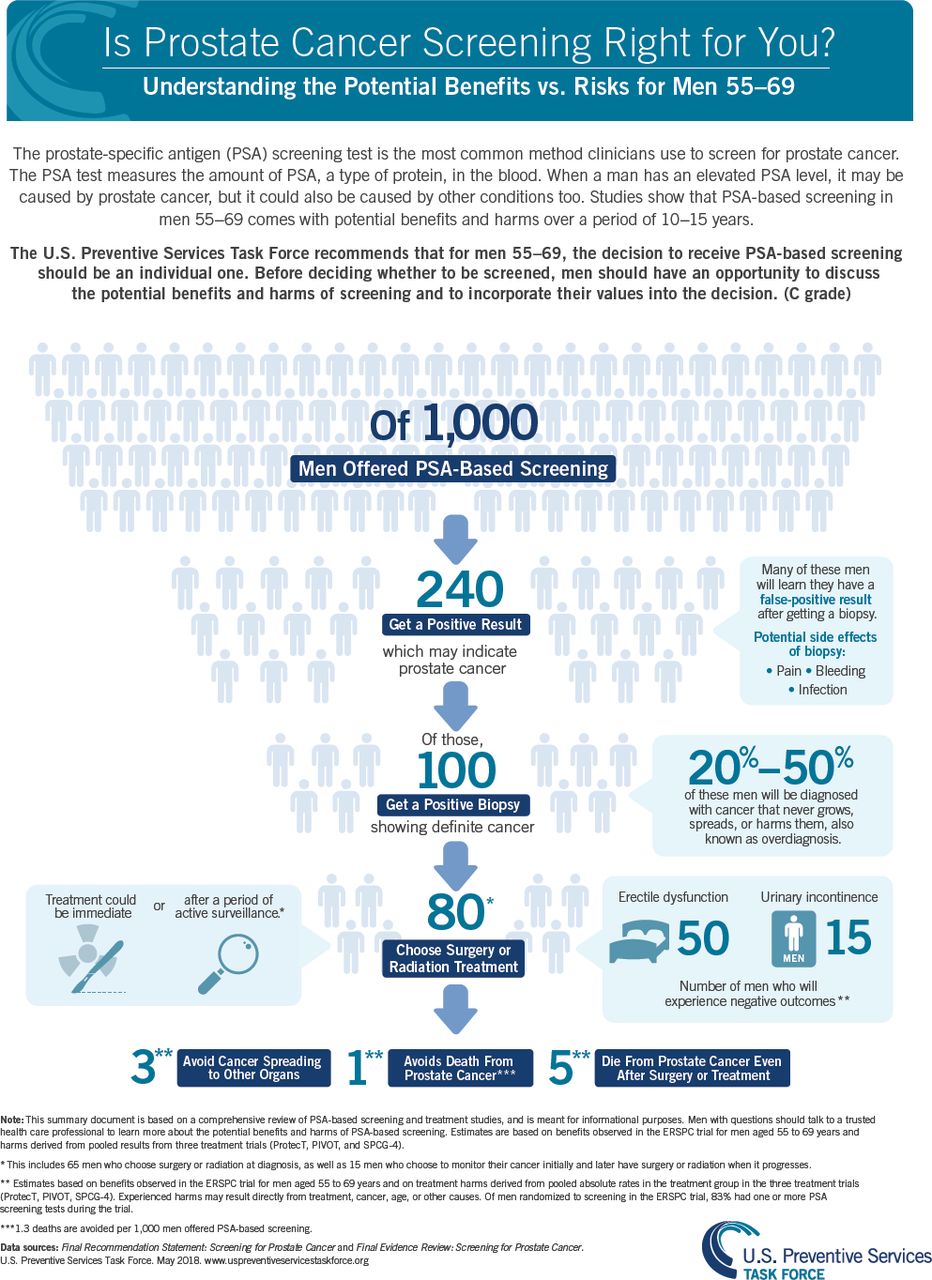


[12h](https://www.astralcodexten.com/p/should-people-avoid-whole-body-screening/comment/281078016 "Jun 23, 2026, 2:29 AM")
The possible harms don't stop at anxiety and biopsies, though. You also need to consider the risk of significant harms from over-treating indolent cancers that we can't reliably differentiate from aggressive cancers, like what can happen with impotence and urinary incontinence from over-treatment of prostate cancer in response to prostate specific antigen screening.


[11h](https://www.astralcodexten.com/p/should-people-avoid-whole-body-screening/comment/281081508 "Jun 23, 2026, 2:39 AM")
Ah yeah both my father and I had life threatening conditions that would have been easily caught with whole body scans. He has permanent damage to his bladder and has to catheter 3 times a day now because his doc did not send him for a scan. In my case I had to go to the er and demand a scan after my insurance rejected it. As it turned out I was going into organ failure and would have been dead within 12 hours without that scan. So yeah I am a big fan of whole body scans.

[2h](https://www.astralcodexten.com/p/should-people-avoid-whole-body-screening/comment/281248740 "Jun 23, 2026, 12:18 PM")
Was the ER a CT scan or an MRI scan, or an xray?


[11h](https://www.astralcodexten.com/p/should-people-avoid-whole-body-screening/comment/281082069 "Jun 23, 2026, 2:40 AM")
This analysis reminded me of the work of psychologist Gerd Gigerenzer. He has written extensively on the harms, overdiagnosis, and poor statistical communication surrounding prostate-specific antigen (PSA) screening for prostate cancer. He wrote "Cancer screening does not save lives." This editorial published in Healthcare in Europe, details how patients are frequently misled about the true benefits and harms of cancer screening.
Other publications along these lines include "Public knowledge of benefits of breast and prostate cancer screening: A cross-validation in nine European countries" – Published in the Journal of the National Cancer Institute. This article analyzes how vast numbers of men grossly overestimate the benefits of PSA tests while being uninformed of the risks of overdiagnosis.
"Effect of Tabular and Icon Fact Box Formats on Comprehension of Benefits and Harms of Prostate Cancer Screening: A Randomized Trial" – Published in Medical Decision Making, this study explores how presenting clear, transparent statistical facts impacts patient decisions.


[11h](https://www.astralcodexten.com/p/should-people-avoid-whole-body-screening/comment/281082315 "Jun 23, 2026, 2:41 AM")
Wait back up, this implies the average seemingly-healthy person has a 1% chance of currently having cancer? That seems distressingly high
(It passes the smell test - if about half the people ever get cancer and life expectancy is 80 years that's about 1/160 of getting a new cancer every year. But this includes old and unhealthy people and assumes you could have cancer for a year without knowing about it until you took the full body scan. I'm guessing most cancers affect the elderly more? Man, fun new source of constant medical anxiety).

[11h](https://www.astralcodexten.com/p/should-people-avoid-whole-body-screening/comment/281087747 "Jun 23, 2026, 2:57 AM")
However big of a deal you think cancer is, it’s actually much worse than that.

[11h](https://www.astralcodexten.com/p/should-people-avoid-whole-body-screening/comment/281088602 "Jun 23, 2026, 3:00 AM")
Author
This is true of fifty-something year olds (the population from whom these stats are drawn) but probably false for people younger than that.


[9h](https://www.astralcodexten.com/p/should-people-avoid-whole-body-screening/comment/281123731 "Jun 23, 2026, 5:06 AM")
Take the prostates of men (who died of something other than prostate cancer) at autopsy and check them for undetected prostate cancer. Results: latent prostate cancer present in 5% of men aged <30 years, increasing to 59% at age >79 years.
As a male in the USA your lifetime risk of symptomatic prostate cancer is ~10%, and you have a 3% chance of dying from the disease. Risk is greater for African Americans. Anyone you treat for prostate cancer risks incontinence and impotence for the rest of their lives.
All numbers taken from https://doi.org/10.1002/ijc.29538


[11h](https://www.astralcodexten.com/p/should-people-avoid-whole-body-screening/comment/281082316 "Jun 23, 2026, 2:41 AM")Edited
20+-year oncologist here: the data clearly and repeatedly shows that we treat too many breast cancers that would never be dangerous, and 5x that many never-life-threatening prostate cancers (among many others, but those are the top two in women and men respectively, so a good, non-cherry-picked sampling).
And the QOL-cost of this treatment is truly massive, beyond what you report here Scott. Specifically, for both of those cancers we give treatments that take away people’s estrogen/testosterone, and in so doing take away a big part of who those people are, how they function, and even how they see themselves as humans. We change their lives, permanently, and not for the better.
The reason experts advise against asymptomatic whole body scans (and avoid them ourselves) is because we believe the data, not to mention our own eyes.


[2h](https://www.astralcodexten.com/p/should-people-avoid-whole-body-screening/comment/281252820 "Jun 23, 2026, 12:27 PM")
"[We] advise against asymptomatic whole body scans ... because we believe the data, not to mention our own eyes"
I understand and am sympathetic to the pragmatic logic, but remain stuck on the question:
Why can't the people who "treat" the innocuous cancers believe the data, and make good decisions?
Roughly:
- inertia + cultural presumption that aggressive early intervention would be positive
- general bias toward action / involvement (surgical industrial complex has incentive survival mechanisms?)
- pressure from relatively low-info high-anxiety patients
- ignored positives present higher legal liabilities than treated negatives
The first two should be easy enough to overcome if we believe medicine has anything like a scientific or technocratic arc.
The third - evidenced in this comment section by a Korean anecdote - I believe is a cultural artifact that would settle on a new equilibrium pretty quickly if mass-market scans revealed that everybody's uncle, cousin, and neighbour was carrying weird internal anomalies.
The fourth is furthest from a natural / automatic solution, but it does seem tractable in terms of documented evidentiary decision making? Individual patients will be outliers in so far as their conditions are actually much worse / more urgent than our understanding lets us guess.


[11h](https://www.astralcodexten.com/p/should-people-avoid-whole-body-screening/comment/281083199 "Jun 23, 2026, 2:44 AM")
My case: I was constipated for years after a motorcycle accident. Got worse and worse until I was going about once every two weeks and was basically living on soup. I saw multiple doctors who just told me to eat more fiber (I was in my 20s). Out of desperation: I got a prenuvo scan - I had an internal hernia. Got surgery and felt loads better. Night and day. No regrets!


[8h](https://www.astralcodexten.com/p/should-people-avoid-whole-body-screening/comment/281134553 "Jun 23, 2026, 5:51 AM")
This makes me wonder what the QALY yield would be from a protocol of "use whole body MRI as a backup diagnostic tool for people who have weird persistent debilitating/painful/annoying symptoms not resolved by the easy/simple stuff." Where you set the threshold for debilitating/painful/annoying probably matters, but seems plausible that it might target a higher yield population than the worried well.

[11h](https://www.astralcodexten.com/p/should-people-avoid-whole-body-screening/comment/281084873 "Jun 23, 2026, 2:49 AM")
Is there no value for the ~2/3rds of patients who got a full body MRI, and it came back clean? Why would giving "peace of mind" to someone who might be nervous count for zero QALYs, while giving the remaining ~1/3rd "anxiety" count for negative QALYs?

[11h](https://www.astralcodexten.com/p/should-people-avoid-whole-body-screening/comment/281088857 "Jun 23, 2026, 3:01 AM")
Author
Most people who get these are healthy with no symptoms. I don't think their anxiety decreases very much, but maybe I'm underestimating health anxiety.

[2h](https://www.astralcodexten.com/p/should-people-avoid-whole-body-screening/comment/281252485 "Jun 23, 2026, 12:26 PM")
I think you may be ... missing things that people would like to know about. "I have a hole in my skull" level of "we found this on the nMRI." Or "Your spine is melted, sorry, we can't treat that."
It is helpful to get diagnostics that say "something is wrong here" even if there's no projected treatment.
Cancer may be uniquely "distressing" (but not depressing). Most other diagnoses, even untreated/not-problems do not carry the "IMA DIE" issue.


[11h](https://www.astralcodexten.com/p/should-people-avoid-whole-body-screening/comment/281090051 "Jun 23, 2026, 3:05 AM")
If the roi of promethease were calculated this way, what would it show?
No, because 1) although it gives people many more negative hits of info 2) people have adjusted
I don't think it's right to port over the costs unchanged from a world where patients believe "tests are all meaningful and expensive and only docs can request them, so a potential problem is serious" and then plug them into a world where scans are way cheaper and faster and don't need a doctor.
By not accounting for adaptation, this kind of analysis seems like it would show that most tech or system changes should not be or have been made.

[11h](https://www.astralcodexten.com/p/should-people-avoid-whole-body-screening/comment/281094549 "Jun 23, 2026, 3:20 AM")
Author
First of all, this analysis tries to minimize the effect of actual irrationalities and cultural problems, and show that even if all of those get assumed away, this is still low yield.
Second, I don't think we should assume those away. Segways might be a revolutionary invention if everyone switched them all at once and we replaced all of our car infrastructure with Segway infrastructure, but the fact that they require this unlikely thing means they probably aren't worth you personally buying unless you're feeling incredibly optimistic. Likewise, every dating site would be great and life-changing if the culture changed so that all of the highest-value singles in the world used that dating site, but that doesn't mean that dating site is good today, or that you should use it, or that it's a genius revolutionary invention. Coordination problems are often the hard part, and if you've solved everything except the coordination problem then you often haven't done very much.

[10h](https://www.astralcodexten.com/p/should-people-avoid-whole-body-screening/comment/281102636 "Jun 23, 2026, 3:46 AM")
What do you think uptake would look like? I modeled a gradual rollout with those especially needing it (people with DNA or family history reasons to rationally want to be scanned more often) self selecting in.
And in the background as a pressure on the mainstream, all good things to me. A broad day one rush of likely false positives would be bad - but I'm curious to know if that's something we couldn't adapt to?
The value "try to know more things about health, medicine etc" is so close to what I care about, I didn't expect the reactions against it so strongly. (I'm only referring to the case it works and eg raises scan rates 100x due to cost but with 2x worse false positives. if it doesn't work at all then it'll fail w/out opposition.) What could happen which would really lead to big problems?
I'd expected docs to be more scared to appear openly against generic "progress" measured by naive abilities like speed, etc.

[11h](https://www.astralcodexten.com/p/should-people-avoid-whole-body-screening/comment/281094749 "Jun 23, 2026, 3:20 AM")Edited
I think you alluded to this in your first post, but the base rate for "newly expanded screening procedure for healthy adults improves health outcomes" is very poor. Are there any screening procedures (of any kind) that are currently recommended for healthy adults aged 18-40? HIV test for sexually active adults maybe? Even a lot of the traditional ones (mammograms for example) are not slam dunk in terms of cost benefit in the general population.
Also I think you downplay the risk of biopsies a little bit: we are not always talking about minor side effects; you can get antibiotic-resistant infections, sustain serious brain or organ damage, or die from a biopsy. Rare, yes, but it does happen -- sometimes I think people just brush it aside into the category of "the band-aid might cause skin irritation."


[4h](https://www.astralcodexten.com/p/should-people-avoid-whole-body-screening/comment/281204110 "Jun 23, 2026, 10:21 AM")Edited
Presumably getting one's blood pressure checked is useful, or at least really cheap if you happen to be at a doctor's office for any other reason.

[1h](https://www.astralcodexten.com/p/should-people-avoid-whole-body-screening/comment/281255073 "Jun 23, 2026, 12:32 PM")Edited
Diabetes screening, blood pressure, weight -- these all get routinely tested. Eyeballing your feet to make sure you don't have ulcers-you-didn't-see is also a screening procedure (which is a handy way to point out that "doctors do a lot in a very short amount of time"). Neurological testing (knee jerk test, which is amusing if you suppress the response) is also done with relative frequency. Ditto "breathing", which checks for a number of issues.
https://assets.cureus.com/uploads/review_article/pdf/344597/20250402-84176-ypekuu.pdf
STDs, Smoking, Obesity -- lots of "lifestyle" type changes, including intimate violence.
Also, there's the "please please please" take a multivitamin, headless babies are bad (women only, naturally, but not all women plan pregnancies, so important).

[11h](https://www.astralcodexten.com/p/should-people-avoid-whole-body-screening/comment/281096742 "Jun 23, 2026, 3:27 AM")
I think the "people won't do the basics" is outdated. Almost 50% of adults get 150 minutes of mild exercise a week, and 25% do "muscle strengthening". 20% of people go to a gym/fitness class in a given week. These numbers include all adults, including decrepit elderly people. Among 18-30 2/3rds of people meet exercise requirements. Basically every food product line is updating as people learn that protein and fiber are good for you. The same doctors who complain that people won't lose weight or change anything are annoyed that people keep coming to them proactively for things they deem not "real" health issues like trouble sleeping or minor pain.
There are a ton of people willing to make pretty large sacrifices for health and wellness.

[10h](https://www.astralcodexten.com/p/should-people-avoid-whole-body-screening/comment/281098620 "Jun 23, 2026, 3:32 AM")
How does the doctor's liability concerns fit into this calculation?
In spherical cow land, the doctor is thinking Pr[this finding is treatable cancer] vs Pr[this finding is no biggie/not treatable/doesn't need to be treated]. But it seems like in reality, at least in the US, the doctor is also thinking Pr[this finding looks innocent but isn't and I get sued by this guy's heirs for a gazillion dollars and my malpractice insurance goes up by 200%].


[10h](https://www.astralcodexten.com/p/should-people-avoid-whole-body-screening/comment/281103477 "Jun 23, 2026, 3:49 AM")
The massive QALY burn from chasing underspecified MRI anomalies is an exact manifestation of a broader, systemic failure in how we apply Bayes. The medical system consistently forces continuous, structurally underspecified reality into discrete, fully-specified models.
The mathematical boundary of this error, what I refer to as the Observational Sufficiency Principle (OSP), is by reverse-engineering the most notorious example of Bayesian overconfidence: the textbook 2/3 consensus on the Monty Hall Problem.
The standard Monty Hall solution commits is a Fully Specified Stochastic Process (FSSP) error. To force the math to work, the analyst hallucinates a generative protocol for the host (q=0.5) that was physically unobservable. They import a spurious rule of selection to complete the model.
This is exactly what is happening with whole-body screening. When an MRI flags a 'mildly concerning' shadow, the generative process of that shadow is entirely underspecified. But instead of treating it as an equivalence class, the diagnostic model forces an FSSP onto it, hallucinating a precise risk likelihood that generates the 300 false-positive follow-ups Scott calculated.
When you apply a rigorous quotienting step to an actual underspecified observation space - restricting the σ-algebra to only what is admissible (the equivalence class under permutation π) - the posterior is mathematically forced to respect the indistinguishability, dropping the overconfident probabilities back to 1/2.
The insistence on completing underspecified models with post-hoc likelihoods is why predictive models hemorrhage value, whether on a game show stage or in an MRI machine.
The full π-invariance quotienting proof and taxonomy of the FSSP category error are mapped out here:
Your thoughts?

[4h](https://www.astralcodexten.com/p/should-people-avoid-whole-body-screening/comment/281205700 "Jun 23, 2026, 10:26 AM")Edited
::click link::
As I suspected, it's written in a way that is difficult to understand and triggers my nonsense detector. Would not recommend.


[10h](https://www.astralcodexten.com/p/should-people-avoid-whole-body-screening/comment/281113166 "Jun 23, 2026, 4:24 AM")
"A few years ago, my aunt had some concerning symptoms and got a scan. The scan showed she probably had cancer. The doctor inexplicably ignored it for several months and she died. RIP."
...were they sued into oblivion?

[8h](https://www.astralcodexten.com/p/should-people-avoid-whole-body-screening/comment/281142977 "Jun 23, 2026, 6:25 AM")
Not to comment on Scott's aunt, but I think doctors prefer not to jump straight off to "it could be cancer" because of the fear of terrifying the patient. I had that with an appointment for a particular minor surgical procedure, where I could tell the consultant suspected it might be cancer but refused to tell me, so of course when I got home I immediately looked it up online and yes, the result came back "with this set of symptoms in this type of patient, first suspicion is cancer".
I didn't freak out because I knew it wasn't cancer (for various reasons too detailed to go into here) so I was more annoyed the doctor wouldn't be honest with me, but to be fair, had he said "it could be cancer" and had I been less certain of my grounds, I probably would have worried myself into oblivion over what turned out to be, when the results of the procedure came back, "no it's not cancer".


[9h](https://www.astralcodexten.com/p/should-people-avoid-whole-body-screening/comment/281115241 "Jun 23, 2026, 4:32 AM")
899 hours at the doctor to save 900
This fails to factor in that I'd rather be unconscious (dead) than be at the doctors.

[9h](https://www.astralcodexten.com/p/should-people-avoid-whole-body-screening/comment/281116337 "Jun 23, 2026, 4:36 AM")
This is an impressive ICER exercise. But as you’ve alluded to, any ICER is predicated on the intervention actually being effective…and I’m not aware of any outcome evidence of whole body MRI to that effect. You’ve made some best (and no doubt learned) guesses here but of course that doesn’t replace outcome evidence.
In the end, I suspect this will appeal to the subset where money is no object….the folks who do stuff because they can, even absent evidence that they should (probably considerable overlap with the longevity types also). In that way, this is part and parcel of the whole boutique/concierge/executive medicine trend that exists to cater to the worried well.


[9h](https://www.astralcodexten.com/p/should-people-avoid-whole-body-screening/comment/281118714 "Jun 23, 2026, 4:45 AM")
You say "In the past when doctors have come up with clever cost-benefit analyses like the one in this post, these sorts of known unknowns and unknown unknowns have predominated, and the real effects have been much different from the expected effects - usually much worse."
Do you have any examples?

[9h](https://www.astralcodexten.com/p/should-people-avoid-whole-body-screening/comment/281120063 "Jun 23, 2026, 4:51 AM")Edited
As opposed to whole body MRI for which there is no outcome data, and whole body US which has even less, what are your feelings about PSA and/or colonoscopy, given the body of evidence available regarding those tests/procedures?

[9h](https://www.astralcodexten.com/p/should-people-avoid-whole-body-screening/comment/281125906 "Jun 23, 2026, 5:15 AM")
On colonoscopies, I found this article worthwhile reading: https://asteriskmag.com/issues/04/you-re-invited-to-a-colonoscopy .

[6h](https://www.astralcodexten.com/p/should-people-avoid-whole-body-screening/comment/281165718 "Jun 23, 2026, 7:56 AM")
Thanks for that. That’s a good summary and discussion of NordICC. Intention to treat analysis is the gold standard in RCT as it preserves the effect of randomization (as opposed to on-treatment or per-protocol)…and the screening strategy IS the “treatment” here…so I don’t understand the fuss. If someone did an RCT about a surgical procedure and only included those in the “treatment” arm who actually underwent the surgery, they would be roundly mocked, and deservedly so.


[9h](https://www.astralcodexten.com/p/should-people-avoid-whole-body-screening/comment/281120101 "Jun 23, 2026, 4:51 AM")
I'm not super optimistic about full body scans as the best investment in medical technology, but Midjourney's plan before this was to marginally improve image generation models. Image generation is mostly zero-sum imo (a bit of a hot take, but can we at least agree a lot of the rewards to Midjourney come from competing with other mildly inferior image sources instead of providing actually new and good services?) So it's better for them to be working on full body scans even if they're very overhyped, as long as they somehow won't do a bad enough job to set the field back worse than had they never entered. The only exception is if the availability of full body scans is somehow negative, and even if they're bad for most people there has to be some way to restrict it to people who can benefit, like those who can't have an MRI for whatever reason.

[9h](https://www.astralcodexten.com/p/should-people-avoid-whole-body-screening/comment/281124601 "Jun 23, 2026, 5:09 AM")
I think it's important to consider that we have arguably already caused great harm and wasted a great many resources through overzealous screening. H. Gilbert Welch has some nice work suggesting that screening mammography and other popular forms of cancer screening have not actually liked them lives but have led to many, many more people receiving toxic therapy that couldn't have helped them.
So while I think it's peobably true that screening which costs nothing and is undertaken by perfectly rational actors cannot harmful, we already have several decades of history of screening being harmful.

[9h](https://www.astralcodexten.com/p/should-people-avoid-whole-body-screening/comment/281127172 "Jun 23, 2026, 5:20 AM")
This suffers from spherical cow in another direction. Even if everything above is correct and even optimistic: we're moving FAST in a direction where the capacity to analyze data increases by orders of magnitude (plural). What Claude Code can do with your genome, clinical data and MRI history is already more than any single doctor will ever have the patience to do. It currently needs guidance and common sense provided by a human - but It's a matter of months until you get harnesses which prevent its worse mistakes. And then you get Mythos gen models and better harnesses.
So not else is being equal. 3 years ago this all was, at the very least, debatable. But now the "more data" camp wins hands down.

[9h](https://www.astralcodexten.com/p/should-people-avoid-whole-body-screening/comment/281127999 "Jun 23, 2026, 5:24 AM")
I always thought one of the main objections by doctors to scanning healthy patients is because MRI machines, operators of the machines, and interpreters of the scans, are all a constrained resources, that are better distributed to patients who are sicker.
I also think that if such scanning and the knowledge of "minor cancers" became much more commonplace, the general sentiment and level of anxiety regarding them would calibrate itself. re the comment on Taiwan


[9h](https://www.astralcodexten.com/p/should-people-avoid-whole-body-screening/comment/281128183 "Jun 23, 2026, 5:24 AM")
Good post.
1. If the cost/benefit is so close, why do doctors insist that multiple large trials of preventative screening have been done and failed, across multiple types of cancer?
2. Why are we even talking about cancer in response to the Midjourney announcement? AFAICT they said nothing about cancer or tumors in any of their announcements. All this made sense several months ago when we were talking about Prenuvo, but all Midjouney has said they will do is provide body composition info and then later apply to the FDA for more stuff.


[9h](https://www.astralcodexten.com/p/should-people-avoid-whole-body-screening/comment/281128704 "Jun 23, 2026, 5:26 AM")
I think the elephant in the room is the value of the data, independently of how they are immediately used to benefit individuals patients. Imagine you collect a few millions of full body scans and you also follow up the patients, learning long term outcomes. You will be able to train a predictive model that may turn out to be invaluable for future patients. Whether you see this as a data grab or as a great opportunity for future patients, this is likely to matter more than the impact on current patients.


[8h](https://www.astralcodexten.com/p/should-people-avoid-whole-body-screening/comment/281133182 "Jun 23, 2026, 5:45 AM")
As a periodic somaticizer myself, I'd like to offer another perspective:
Every couple years, I find myself developing the symptoms of some terrible disease. I ignore it for some time, but inevitably convince myself that This Time It's Real and I go to some number of doctors. I'm young, so they often tell me that I am probably fine and do not have the disease in question, despite my symptoms. Sometimes they do not want to order tests for me. My symptoms continue to worsen, and I perseverate on their hubris and poor epistemics. They are working in a low information environment, their medical training does not effectively calibrate them to rare conditions, they rarely get feedback when they miss a diagnosis, my med-school-dropout-professor was right in saying that doctors are rhe least intellectually curious people in the world, etc
Eventually I am able to get the tests, and these tests show me that I do not have the disease. Suddenly, my symptoms are gone and I am cured.
The point being: Negative results can be emotionally valuable.
Over the next 10 years, I expect to develop at least one terminal, ultrasound-detectable condition. If these tests were cheap and accessible, I could skip straight to the cure. If not, I'd guess it would take a month or so of grief and perseveration to get an (insurance-covered) MRI.

[8h](https://www.astralcodexten.com/p/should-people-avoid-whole-body-screening/comment/281133962 "Jun 23, 2026, 5:49 AM")Edited
I find those tweets curiously enraging, and I think it's because these are the types who would otherwise be smugly "trust the science, bro; look, just hand over control of society to the technocrats and it'll be perfect" but when it comes to this, then they're all "waaah, why is the mean ol' Harvard physician not letting me, a tech head, play with the shiny new toy I want to play with? what does he know, anyway!". Also perhaps a hint of "I am so well-established in life that I can afford the kind of health insurance that will pay for fripperies, because I am Smart and Educated and High Value Human Capital" at play as well.
You know what, Midjourney? I was highly dubious about this entire project but now I say "Go right ahead. Slap AI on everything! Soak these pigeons for every dollar you can squeeze out of their high value backsides! Make it an entire spa package and charge 'em $$$$$$$ for what in effect is a Seltzer bath with knobs on!"
I figure these are the types who probably were all over NFTs as well, so if they're going to throw money away, why not scoop it up in a pivot from "we help you draw your own porn tailored to your specific kinks" to "ah yes, the field of medicine, a vast plain of opportunity for quackery dressed up in the latest buzzwords".
"If you don't otherwise have symptoms, ignore the scan", forsooth! Hey, Amanda, how's about if you don't otherwise have symptoms, you don't get the scan in the first place, and save all the time and bother?
If these people want 24/7 monitoring of their health so they can gather data, then I say let 'em have it, hot and heavy. Blood draws every hour on the hour. All the poking and prodding and hanging around and "take off all your clothes and put this skimpy paper gown on and then sit around waiting until a doctor deigns to poke his head around the door" galore. Tests, tests, and more tests, till they don't know whether they're coming or going.

[1h](https://www.astralcodexten.com/p/should-people-avoid-whole-body-screening/comment/281266380 "Jun 23, 2026, 12:54 PM")
Are you also okay with people getting injections of unborn baby? (blood, I think? fetal cells).

[8h](https://www.astralcodexten.com/p/should-people-avoid-whole-body-screening/comment/281136957 "Jun 23, 2026, 6:01 AM")
"If any real person went to their doctor for an hour daily for years to decrease their risk of cancer by 5%, we would call them an insane hypochondriac!"
The good old-fashioned term for doctor-botherers is valetudinarian, and the likely market for this procedure. Perhaps we should call them Sholtos, in honour of the example of the species as per Conan Doyle's "The Sign of the Four":
“This is Mr. Sherlock Holmes, and this is Dr. Watson.”
“A doctor, eh?” cried he, much excited. “Have you your stethoscope? Might I ask you—would you have the kindness? I have grave doubts as to my mitral valve, if you would be so very good. The aortic I may rely upon, but I should value your opinion upon the mitral.”
I listened to his heart, as requested, but was unable to find anything amiss, save indeed that he was in an ecstasy of fear, for he shivered from head to foot. “It appears to be normal,” I said. “You have no cause for uneasiness.”
“You will excuse my anxiety, Miss Morstan,” he remarked, airily. “I am a great sufferer, and I have long had suspicions as to that valve. I am delighted to hear that they are unwarranted. Had your father, Miss Morstan, refrained from throwing a strain upon his heart, he might have been alive now.”
...“That is well! That is well!” said he. “May I offer you a glass of Chianti, Miss Morstan? Or of Tokay? I keep no other wines. Shall I open a flask? No? Well, then, I trust that you have no objection to tobacco-smoke, to the mild balsamic odour of the Eastern tobacco. I am a little nervous, and I find my hookah an invaluable sedative.” He applied a taper to the great bowl, and the smoke bubbled merrily through the rose-water.
...I stammered out some few halting words of congratulation, and then sat downcast, with my head drooped, deaf to the babble of our new acquaintance. He was clearly a confirmed hypochondriac, and I was dreamily conscious that he was pouring forth interminable trains of symptoms, and imploring information as to the composition and action of innumerable quack nostrums, some of which he bore about in a leather case in his pocket. I trust that he may not remember any of the answers which I gave him that night. Holmes declares that he overheard me caution him against the great danger of taking more than two drops of castor oil, while I recommended strychnine in large doses as a sedative."

[8h](https://www.astralcodexten.com/p/should-people-avoid-whole-body-screening/comment/281142085 "Jun 23, 2026, 6:22 AM")
So in total, 8 of the 1,000 people have benefited. The average benefit among those 8 people is 4 quality-adjusted life-years, so the total benefit from the scans is ~32 QALYs.
What’s the total cost?
I don't think this is a good framework in which to view the policy issue. One benefit of doing regular scans of normal people is that you develop a sense of what normal scans look like. (And also a sense of what abnormal scans look like!)
This means that the scans become more valuable over time, because we can interpret them more reliably.
Arguing that they're not very valuable 𝗻𝗼𝘄 misses this point.

[7h](https://www.astralcodexten.com/p/should-people-avoid-whole-body-screening/comment/281148598 "Jun 23, 2026, 6:48 AM")
Is QALYs the right measurement for understanding this? Are the doctors who recommend patients not get screening procedures optimizing for QALYs? Like if suggesting screenings gets a doctor 8 5-star reviews and 992 1-star reviews,and suggesting no screenings doesn't, then the ""best"" doctors will suggest no screenings and have plausible reasons why.


[7h](https://www.astralcodexten.com/p/should-people-avoid-whole-body-screening/comment/281152527 "Jun 23, 2026, 7:04 AM")
How I know I'm not The Exception: routine checkups eventually surfaced that "you probably have prolactinoma, but it's a benign brain tumor, don't worry"...and this freaked me the hell out for years. Every headache that seemed to originate from one particular location, every time vision on one side would go weird, every time "brain fog" would inexplicably descend - it's the brain cancer, I'm dying! And the main reason I never followed up with neurology, despite a recommendation, was indeed cost...attending free city clinics on spotty/no insurance is not a choice a rich person makes. This would have turned out to be a mistake anyway, since things cleared up on their own over time with medication adjustments.
That's the direction I thought the MidScanners section would go - holding the same can opener assumptions steady, let's minimize both the cost and time variables, and also add a further assumption that AI ultrasound magically reaches MRI levels of efficacy. If such a technology had been available back during my scare, would that have actually been a good thing? I don't know! Even if they're all quibblesome numbers, the odds as given don't look especially promising in the median case...so I'm mostly still interested from an R&D Yay Progress standpoint. AI has already done hat tricks with far less, or so they say.

[7h](https://www.astralcodexten.com/p/should-people-avoid-whole-body-screening/comment/281158871 "Jun 23, 2026, 7:29 AM")
Surprised you didn't address the "if we have squillions more scans, then AI can process them and get vastly more capable at discriminating stuff that matters from the rest" claim. More broadly, it's a mistake to think that the medicine of 5 years ago looks anything like the medicine of 10 years from now.

[6h](https://www.astralcodexten.com/p/should-people-avoid-whole-body-screening/comment/281160374 "Jun 23, 2026, 7:34 AM")
There’s a Nate Soares quote that breaks my brain ‘there may well come a day when humanity would tear apart a thousand suns to prevent a single death.’ It’s part of his discussion of how the cost of a life isn’t the value of a life.
But while money is a mostly-adequate measure of costs and values, it’s still an artefact to try and measure something else that we actually care about. I think this is the same point as not actually wanting to spend 800 hours in scans for 4 more years of life, or the old joke ‘Exercise doesn’t make you live longer, it just feels like it.’ If building a scanner involves torturing small children to work in heavy metal mines, and going for a scan involves hours of waiting in hospitals and months of anxiety, whatever cost the economics has put on that might not be a good measure of the cost. On the other hand, if getting a scanner involves some bored teenagers and an AI being super happy doing a summer project, and getting scanned involves walking into Starbucks through a gate that snoops your health and never tells you if you don’t need to worry, that’s different.
I think medics have a very good pragmatic feeling for ‘what is worth it’ and a really good sense that we’re all going to go of something anyway (doctors’ approach to end of life care / chemo etc is really interesting) and that’s why they come down more anti whole body scanning than the numbers suggest.
With the infinitely rich man, the cost of the scan is trivial, but the value / opportunity cost of his time is more complicated - at the moment we end up with the cost of a QALY being about ‘if a normal person worked normally for a year, they could buy a year of life’, which feels a normal thing for the market to do. But if you are infinitely rich, you’re saying ‘I’d rather be sitting in this scanner and having these tests than be going into low earth orbit or eating grapes peeled by the attractive people of my choice’ - they might value their time now more than their expected time aged 80 (which is where the 4 extra years are likely to go)

[5h](https://www.astralcodexten.com/p/should-people-avoid-whole-body-screening/comment/281188329 "Jun 23, 2026, 9:23 AM")Edited
I somewhat disagree that "more scans" reduces the marginal benefit. In the extreme (which to be clear I don't believe is still even remotely close to possible) where I can every day just get in the bath and have a whole-body scan done, same as I could step on a scale and weigh myself, then the benefits clearly go back to being positive. There is no "is this zit dangerous?" question any more. I can just wait a few days and monitor its size precisely; its trajectory will say whether I need to worry or not. The anxiety is greatly reduced. For a comparable example of something I can already do - all the little defects would become equivalent to the defects I can already see: the moles on my skin. I look at my moles and check them. I know one of them COULD be cancer. Occasionally I get a scare by one that really looks a bit weird and keep a close eye on it for some time, but then I see it doesn't really behave any more weirdly than the others and relax. Very occasionally I go to a doctor to have it checked. And very very occasionally (this has happened twice to me) the mole is annoying, painful, or worrying enough to get it surgically removed. But ultimately, the mundanity of it all means my bar adjusts; and I'm a comparatively rather anxious person.
There probably is a minimum somewhere in there - an amount of scans that is the worst possible amount, enough to cause worry and not enough to deliver the ideal benefits. But at very very high frequency, daily scans are obviously better than no scans.


[4h](https://www.astralcodexten.com/p/should-people-avoid-whole-body-screening/comment/281192599 "Jun 23, 2026, 9:39 AM")
I place myself in the following category.
I’m a rich person who doesn’t care about time or money, and is immune to anxiety, and won’t make irrational decisions.
The reason I would get a Full Body Scan (FBS) is so that I have a documented reference point for any future health issues that may/or may not be easily identified. The hope is that having a comparative scan at a previous point in time could potentially help identify an issue sooner and track the growth rate. For example detection of an Aortic Root Dilation change could be the difference between living 1 year or 20 years if not diagnosed separately.
I would rather have the opportunity to spend my savings on holidays and memories with my partner than die and leave it to the government to not spend wisely.


[4h](https://www.astralcodexten.com/p/should-people-avoid-whole-body-screening/comment/281196492 "Jun 23, 2026, 9:53 AM")
Is there no way to have better thresholds for when to escalate care and when not to? Maybe the scan shows a small, likely insignificant finding. Then you don't do followup. Or it shows a really big, bad finding. Then you do followup.


[4h](https://www.astralcodexten.com/p/should-people-avoid-whole-body-screening/comment/281197705 "Jun 23, 2026, 9:58 AM")
1) This seems like a pretty long-winded way of saying that it's all about the cost and accuracy of the technology. More information is always good, but current tech is too costly. Well... isn't that exactly midjourney's pitch?
2) regarding the negative QALYs from anxiety. I don't buy the model. People are afraid of death, bodily malfunction / decay, etc. Their first encounter with it will always be scary. But this is a fixed cost. There's only so much shit to give about death.
Anecdotally, people get more relaxed about it once they've faced it in some form. It follows that the total QALY loss is simply time shifted. It doesn't matter whether you have to work through those feelings based on a medical scan, your neighbor suddenly dying, or what have you. It's unfair to put this cost entirely on the balance sheet of the scan itself.
Furthermore, the culture will eventually adjust to the new reality. An incidentaloma wouldn't be scary if you had literally dozens of people around you treating it as a normal thing that happens. There are many well-understood dangers in the world that don't induce constant anxiety.


[4h](https://www.astralcodexten.com/p/should-people-avoid-whole-body-screening/comment/281203097 "Jun 23, 2026, 10:17 AM")
A comment on the 'anxiety' aspect, which I think most healthy people will discount as overblown, or paternalistic. You probably feel that in no universe would you ever want to have less information - certainly that was the prevailing opinion on Twitter in most threads I encountered on this debate.
I have multiple sclerosis, and I know something about medical anxiety. I was diagnosed in my late 20s, just after completing the long process of schooling and exams to practice law. I went from being on top of the world, at the height of my optimism and ambition for life, to sitting in a room being told I had lesions on my brain, feeling the walls closing in on me.
MS is indeed a motherfucker of a disease, but three characteristics make it particularly insidious: it is neurodegenerative, progressive, and incurable. The day you are diagnosed, you are told that you will live with it forever, you will almost assuredly get worse over time, and the rate of your worsening is unpredictable.
Most MS patients become obsessed with the future, because we don't know what kind of future we will have. Will we lose our sight? Our ability to walk? We will be exhausted all the time? Or perhaps a mix: we’ll lose 30% of power in one leg, sight in on eye, and be tired most of the time. But even if we accept that these things will happen, it’s difficult to go through life not knowing when. That anxiety over an uncertain future begins to dominate, and become a source of pain all on its own separate from your actual disease course. But I suppose in some deep sense, health anxiety due to the diagnosis is part of the disease too.
An important caveat is that some small percentage of MS sufferers (3-6%) get through life with a benign course that does not affect their lifespan/healthspan. So when you first get scanned, you hope you are one of those lucky few whose initial neurological episode is deemed Clinically Isolated Syndrome - which never develops into full blown MS - or you will continue to get episodes but never progress into real, life-changing disability.
About 6 years ago, I had a stem cell transplant (HSCT) which is the most aggressive treatment for MS, involving high dose chemotherapy and a host of other drugs. It’s risky, it’s very hard on the body, but it resulted in remission for me. For the first 3 years post-transplant, I would regularly have mental breakdowns and periods of depression because I would experience an uptick in some symptoms, and I feared that it must be a sign that the disease had re-activated, and I was back on the descent into hell that was my pre-transplant life.
Eventually, my transplant doctor emailed me back after one of these episodes and just plain told me that I needed to drop my obsession with my condition, and learn to face those fears, because they were doing more damage than anything else. He was right.
It has taken a lot of time to gain some footing against health anxiety. It’s still there, though not as powerful as it once was. HSCT is the best and most effective treatment for my type of MS, but for most people the remission doesn’t last forever. So statistically, I am still expecting a return to active disease. And however much I can tell myself that I have grown, that my psyche is more resilient - I know that deep down, that question mark still hangs heavy over me.
Whatever happens, it is undeniable that I have lost a lot of enjoyment of life that I "should" have had in the last several years because I was worrying about something that had not yet come to pass. And if it does come to pass, then I’ll have just wasted the good years worrying about the thing that came anyway later on anyway.
To Scott's point, if you are a completely rational agent with newly diagnosed MS, you would simply run through the following process: you collect the medical information (how long they think you've had it, how much damage is done), you research the best treatment options available, then pick one, adjust lifestyle factors to minimize severity of disease course, and that's it. That's all you can do. After that, worrying only adds to the level of inflammation your body is already dealing with. But in my experience with fellow MS patients, it's rare to find such a person. There is too much at stake to really just 'let go', even though holding on is not accomplishing anything.
I think 99% of people would find it very difficult to be handed a report saying “You might have a cancerous growth but it’s probably nothing”, and then just trust that report and sleep soundly at night. You can read all these stats that Scott posted, and if you were told that the finding on your full body scan had a 0.1% chance of being something dangerous, you would insist on investigating it fully and completely. I imagine the same for 0.01%, and perhaps even lower.

[25m](https://www.astralcodexten.com/p/should-people-avoid-whole-body-screening/comment/281288294 "Jun 23, 2026, 1:35 PM")
I think you underestimate how much doctors can influence people. I had a full-on bone infection, but the dentist said "come back in six months" -- and I did. Didn't worry about it (more than "something looks funny on the scan" gets worried about -- "what's the biggest downside" and then the "chances it's nothing.").
Six months delay didn't actually hurt anything major.


[3h](https://www.astralcodexten.com/p/should-people-avoid-whole-body-screening/comment/281211595 "Jun 23, 2026, 10:45 AM")
I wonder how the calculation changes for someone who already has a high level of health anxiety.


[3h](https://www.astralcodexten.com/p/should-people-avoid-whole-body-screening/comment/281211738 "Jun 23, 2026, 10:45 AM")
Thanks for doing the sums for me and justifying my, almost certainly irrational, decsion not to have one. I think the self selection problem is huge here - Old men are notoriously reluctant to go to the doctor (in the UK) unless their leg falls off or they grow a third head.


[3h](https://www.astralcodexten.com/p/should-people-avoid-whole-body-screening/comment/281215664 "Jun 23, 2026, 10:57 AM")
One thing you are missing is the fact that everyone is going to die anyways.
If humans were generally immortal unless they get cancer, the benefit to screening for cancer goes way up.
This is a slightly different point than saying that some slow cancers won’t affect you because you’ll be dead before then.
It’s something I’ve thought a lot about because my grandma had ALS, which is mostly not a heritability risk (family members are more likely to have other brain conditions like depression, autism, and schizophrenia, but not ALS), but for like 10% of cases there is a heritable mutation. The heritable form usually starts earlier and takes longer to kill you. At this point I think it’s unlikely given the age of my dad and my aunts and uncles that our family has the heritable form, but when my dad was younger it certainly weighed on my mind a lot. Would I want the genetic testing to know if I had it?
The answer I came to was “no.” I decided that people aren’t meant to know what kills them that early, that psychologically, it is not a developmentally appropriate thing for someone in their 20s to know. If you knew what was going to kill you, you start thinking about what is going to kill your future kids or if you should even have kids. But nobody is supposed to know what will kill their kids.
Developmentally, your early 30s are the time to have an existential crisis, when you start to realize you aren’t going to live forever and need to do something meaningful. But you can’t create meaning about the future thing that will kill you, because by doing so, you are not living in the moment and you are trying to postpone the inevitable, which kind of ruins the whole existentialism vibe.
Since I will die anyways, I do not want to know how until it starts affecting me.

[3h](https://www.astralcodexten.com/p/should-people-avoid-whole-body-screening/comment/281217640 "Jun 23, 2026, 11:02 AM")
Large CT scans are done "on the regular" at Emergency Rooms. I was told it was standard practice by my doctor, and I've yet to go to the Emergency Room and NOT get a CT.
If we go with:
https://www.theglobalstatistics.com/united-states-emergency-department-visits-statistics/
That's 47 visits for 100 people, per year.
Now, it's possible that CT doesn't detect the same "low level" cancers that nMRIs do. But this would suggest that most people in America are getting scanned.
67 scans per 100 encounters (I am not in the Medicare target range).
I went to the Emergency Room with an easily identifiable upon "basic physical exam" condition (that the doctor said she was able to feel), and I left the Emergency Room with no further treatment necessary (a broken rib does not generally require medical treatment). And Yet, I got a CT scan.
This doesn't seem like "we don't give unnecessary tests in America" -- clearly we do, and the spike in x-rays and CTs and everything else suggests a pretty big problem.
We take X-rays of teeth once yearly (that's the dental recommendation). We'd take MRIs at the same rate, were they just as cheap. As it is, the scanning health care is "rationed" based on "who's got a problem 'real enough' to bother looking closely.*"
*aka don't scan purely healthy people.


[3h](https://www.astralcodexten.com/p/should-people-avoid-whole-body-screening/comment/281222624 "Jun 23, 2026, 11:16 AM")
2K per MRI has got to be a huge underestimation. You're going to get bills from both the ordering physician and the radiologist.
Side story: My kid has a bicuspid aortic valve which is an extremely minor heart defect that about 1% or the population has. You can live into old age with no problem, but they say about 50% of people with it will need a valve replacement (which has become a pretty simple non-invasive surgery) by age 50. But in rare cases you can have an aortic aneurysm related to this that causes instant death.
So the protocol is for my son to get an echocardiogram every 18 months. Each time we get bills for around 4K (usually one from the "outpatient hospital" one from the cardiologist and one from the radiologist).
On the one hand--worth it to prevent a catastrophic outcome for my son. On the other hand, over his childhood that's about 24K that could have gone to his college savings account and we have zero proof that any of this screening benefited him at all, as this defect rarely causes problems in childhood and if anything, may cause him problems in old age. 🤷♀️


[2h](https://www.astralcodexten.com/p/should-people-avoid-whole-body-screening/comment/281243709 "Jun 23, 2026, 12:07 PM")Edited
Among the dozen caveats and assumptions, I would add one more: that measuring this makes sense at all, and that the units used for the measurement are the correct ones. Even within broadly utilitarian framework, I would argue this sort of calculation strongly relies on hedonistic utilitarianism with no discountings. Given preference utilitarianism for example, it doesn't strike me at all as obvious that if individuals assigned 100 utils to a lifetime of 100 years, that they would have to assign 105 utils to a lifetime of 105 years (with healthspan correspondingly elongated). Or, even from hedonistic utilitarianism point of view, I think there are reasons for discounting that I find perfectly sound, but that aren't included in the usual QALY calculations, such as (at least in expectation, a couch potato centenarian could in principle pick up extreme sports) reduced amount of novel experiences likely contributing to faster passage of subjective perception of time, which would lead to temporal discounting.
Or, more broadly, while it seems to me that a wise and prudent person would usually follow sound advice from evidence-based medicine, "a life well-lived" (which, as above, even a preference-utilitarian might value) might look less like QALY-maxxing and more like living in the moment and taking a cancer diagnosed too late in your stride. I can see an argument for the opposite ("healthy mind in a healthy body"), but even that would seem to suggest flourishing involving exercise, a healthy diet, etc, not so much delaying the death from preventable disease.


[2h](https://www.astralcodexten.com/p/should-people-avoid-whole-body-screening/comment/281248865 "Jun 23, 2026, 12:19 PM")
TL;DR - tragedy of the commons. What is arguably rational individual behaviour is a collectively bad outcome.
It's a decent QALY analysis at micro-level; it's also blind to macro-level constraints and equilibrium effects. I think it relies entirely on three unexamined assumptions:
1) Scan volume is elastic and can scale with no effects/costs/requirements on units, staffing, or quality.
2) The capacity of the broader medical system for the follow-up cascade is elastic.
3) Neither (1) nor (2) above will displace other patients with the medical system, or that there will be zero QALY costs of such displacements.


[2h](https://www.astralcodexten.com/p/should-people-avoid-whole-body-screening/comment/281251124 "Jun 23, 2026, 12:23 PM")
This argument has been used here in the UK to justify no mass screening for prostate cancer, with the predictable backlash from those who haven't even googled the side-effects of false positives.
Then again, this is early days and when we have enough data AI will be able to catch 90% of the significant cases with no further tests.
The real question we should be asking is: given $x to spend what gives the best health outcomes?


[1h](https://www.astralcodexten.com/p/should-people-avoid-whole-body-screening/comment/281254483 "Jun 23, 2026, 12:30 PM")
As a pathologist who deals with this kind of discussion regularly, I have mixed feelings about it. I got the Galleri test myself. But one thing is certain: there is a downside to a false positives beyond simple cost and anxiety. People seem to be taking the approach of, maybe this finds something useful (positive), maybe it finds nothing (neutral), maybe it finds something to watch (slight downside). But that paints an overly rosy picture. Whether by bad luck or by incompetence, bad things happen, and I've seen things like a 40 year old man who died on the table getting a second biopsy that probably wasn't necessary. A spleen coming out (you need those!) because someone overthought a report. Once in a while I'll make the call myself after numerous failed biopsies and tell the treating doc to stop chasing something, that they should watch and wait because it's almost assuredly nothing. Sometimes it's like they need permission to stop. These are the kinds of things that are difficult to document in a formal way as part of a study. If people want to do this, I don't really have a problem with it, but "Rare and minor side effects of the testing might contribute -0.005 QALYS per person" is cold comfort to someone in the hospital with a collapsed lung after biopsy misadventure chasing nothing.


[33m](https://www.astralcodexten.com/p/should-people-avoid-whole-body-screening/comment/281283929 "Jun 23, 2026, 1:27 PM")
I think it's underrated how fucking annoying it is dealing with medical things. As a middle-aged woman with some health issues, my minimum number of appointments per year is 10 (2 dentist, 2 visits to my normal doctor, 2 blood draws, 2 visits with my cardiologist, 1 echocardiogram, 1 mammogram), assuming no follow-ups. I've had a slightly elevated white blood cell count for years and for the past couple of visits, my doctor has been trying to refer me to a hematologist about it in case I had leukemia. So I finally did that. One visit, one blood draw, no leukemia and it ended there.
Was it likely I had leukemia? No. And I got off easy on the testing this time. But there's always a chance that a hematologist will check you for 20 things, one will be out of range (this is similar to the M&Ms xkcd thing, if you think about it), that will lead to further testing, and then in the end it will either be nothing, or you'll turn out to have some syndrome that requires regular checking for the rest of your life but probably wouldn't have done anything to you if you'd never known about it. Of course there's a small chance your life will be saved, which is why I didn't opt out of the whole thing.
Because I got scanned for atherosclerosis, I know I have a small aneurysm, so I have to monitor that annually in case it grows and kills me. I guess I could choose to ignore it, but that seems hazardous. I guess it's good to know about it. But it also sucks to know about it and it sucks to have a whole echocardiogram about it every year and wonder when it's going to kill me. Probably it would never have killed me.
And I think this is all for screenings that are proven beneficial. Do I really want to know my left ovary is 2% larger than normal? Or there's some funny area on my spleen? I kind of don't.

[27m](https://www.astralcodexten.com/p/should-people-avoid-whole-body-screening/comment/281287630 "Jun 23, 2026, 1:34 PM")
One of my friends is thinking about getting a whole body scan because he wants to have a baseline. I think he might be able to handle hearing about small anomalies.
Top Latest Discussions
Sixty-eight years of highly defective people
Jan 16•Scott Alexander
2,074
876
306

You just keep on trying till you run out of cake
Jan 21, 2021•Scott Alexander
1,590
483
38

Ivermectin: Much More Than You Wanted To Know
Nov 17, 2021•Scott Alexander
442
2,113
5

See all
Ready for more?
Subscribe
© 2026 Scott Alexander · Privacy ∙ Terms ∙ Collection notice
Start your SubstackGet the app
Substack is the home for great culture