Samuel Alito: the Supreme Court's quiet force
0:00
WORLD Radio - Samuel Alito: The Supreme Court’s quiet force
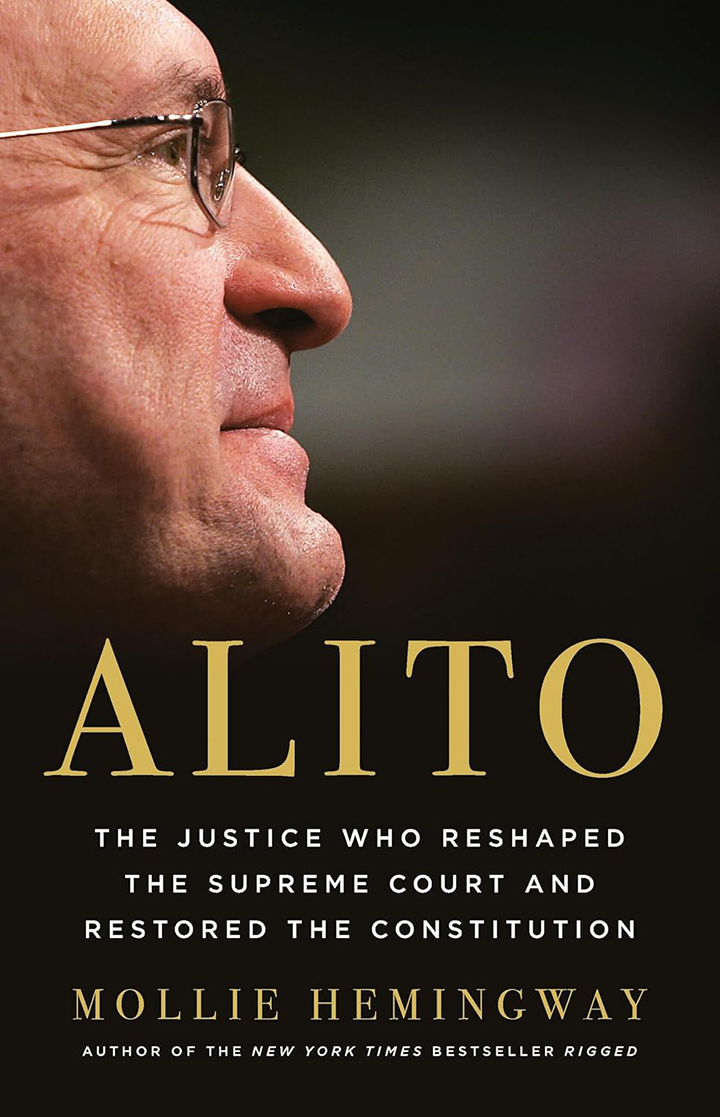
The new book, _Alito_, argues that one of the Supreme Court’s least well-known justices became one of its most consequential—from his New Jersey roots to the _Dobbs_ decision. Our conversation with journalist and author Mollie Hemingway.
Supreme Court Justice Samuel Alito Getty Images / Photo by Alex Wong
LINDSAY MAST: You’re listening to a special weekend edition of _The World and Everything in It_. I’m Lindsay Mast. Earlier this week, you heard a brief conversation with journalist and author Mollie Hemingway about her new book, _Alito_. Today, we have the full interview.
Hemingway calls Justice Samuel Alito “the man who reshaped the Supreme Court and restored the Constitution”–and today she explains why. She traces the life, jurisprudence, and influence of one of the court’s most consequential justices…from his working-class New Jersey roots to the _Dobbs_ decision that overturned _Roe v. Wade_. She also shares new reporting on the pressure campaign that followed the _Dobbs_ leak, the relationships inside the court, and what Alito’s career can teach anyone trying to balance principle with practical results. In just a moment, Nick Eicher’s full interview with Mollie Hemingway.
_ANNCR: Additional support comes from WatersEdge. A larger sanctuary, updated lobby, or expanded children’s area can help strengthen a church’s ministry. WatersEdge Kingdom Investments offers 4.6 percent APY on 15-month term investments. These investments help provide building loans to churches and ministries across the country. Details at WatersEdge.com/invest._
NICK EICHER:For more than a decade here at WORLD, we have followed the Supreme Court closely, listening to oral arguments and tracking decisions, and getting to know the justices in that way—not just for their rulings, but for the way that they think and interact with one another.
Over time, something happens. You begin to recognize the voices and the habits and even their personalities at a certain level.
Mollie Hemingway goes much deeper. Her new book, _Alito_, calls Samuel Alito the justice who reshaped the Supreme Court and restored the Constitution.
Mollie, welcome.
MOLLIE HEMINGWAY: Great to be here with you.
EICHER: Mollie, for listeners who have heard Samuel Alito and can pick him out just by voice in oral arguments but don't really know the man, let's begin there. Who is Samuel Alito?
HEMINGWAY: It's interesting because he's the third-longest-serving justice on the court and is considered by his peers to be a giant on the court, but I'm pretty sure he's the least well-known justice on the court.
He is the son of an Italian immigrant, someone who came as a young child to the United States, the grandson four times over of Italian immigrants, who grew up as a remarkably bright and studious child in a middle-class family. He goes to elite institutions. He retains the values that his family inculcated in him from a young age and is a huge baseball fan, a family man, but not someone we normally associate with positions of power in Washington, D.C., in that he is very humble and modest.
EICHER: What do you think people misunderstand about Samuel Alito? You said that he's been on the court for such a long time but still seems to be the least well known. What do people not get about him?
HEMINGWAY: I'm not sure people realize how influential he is on the court, and he's influential in two major ways.
One, he's known for being the best at oral argument among the conservative justices. Elena Kagan is the best among the liberal justices in oral argument. That's where you can lead your fellow justices to the area that you think a case should be decided upon.
The other thing he's known for is building big coalitions. Some of the justices really care that they get their view out and that it be right, and that is important. You see that in a Justice Scalia, who died in 2016, and a Justice Thomas, whereas Justice Alito thinks more, what is the ground on which we can get the biggest majority to agree and move things in the right direction?
EICHER: You've clearly done your homework, you've done a ton of reporting, interviewed lots and lots of people, and I want to get to that at a later point in our conversation, Mollie, but were you able to pick up a picture of Samuel Alito in conference, and is he different behind the scenes than he is in that up-front oral argument setting?
HEMINGWAY: I actually think each justice is pretty much the same in conference.
What happens is they meet together to do a few things privately. One would be to decide which cases to take for the upcoming term, and then after a case is taken and it gets briefed and there are oral arguments, the justices once again meet in conference to say how they're going to vote on something. They go in order of who has seniority, and they will also decide more specifically on the grounds on which they're deciding something.
They're all the same. Just to take the most recent example, Ketanji Brown Jackson is known for talking a lot on the bench. She talks a lot in conference as well, even though she's the justice with the least seniority. By the time it gets to her, what she says doesn't actually matter that much.
EICHER: Yeah. And how long was it before Clarence Thomas even spoke up during oral arguments?
HEMINGWAY: He used to not speak at all during oral arguments. He didn't like that it was just a free-for-all, and he thought that it was a bit performative.
After COVID, they changed the way they do it, so you actually get called on in order of seniority. People are shocked at how incisive his questions are and that the other justices will follow up on his questions. They're like, “What happened? Where did we not have this guy helping us out here?”
EICHER: Oh, no kidding. And I love his baritone. I love listening to him.
But we're here to talk about Samuel Alito today, a man you have described as just a New Jersey guy. He's got a public-school background, not a typical elite-track justice that you would expect, even though he is Ivy League. He went there because he was just so bright.
How did the New Jersey public-school Italian-immigrant background shape him?
HEMINGWAY: His parents move out of Trenton to a suburb once they have enough money to do that. His parents are people who value education a great deal. He is heavily influenced by his father, who was a nonpartisan congressional research service worker for the New Jersey legislature.
He grows up in this town that is very—it's like a town with different types of people there. They all get along very well.
He later gets the library at his high school named after him, and he considers this his greatest honor because he was so shaped by the teachers and community where he grew up.
When he gets into Princeton, he assumes that he's going to be at a huge disadvantage relative to all of the boarding-school kids that go there. Once he and a few other public-school kids arrive, they realize, actually, we're not threatened by these people at all. We're doing just fine.
He kind of learns that the elites aren't necessarily better in any way than his people are.
You see this with him and Justice Thomas. These are people who abhor the trappings of power. They've never been taken in by Washington, D.C. They couldn't care less if people in a room are bowing down to them. They actually would be very uncomfortable, whereas a lot of people in D.C. enjoy being that vortex of power where everybody comes and tells them how great they are.
He just cares a lot about the people he grew up with. He's still friends with his friends. I interviewed a lot of these people, people that he went to kindergarten with. He's still close to them, and he's rooted there.
EICHER: I've heard you talk about this before in other interviews, but I really love the way you talk about it.
Describe how that actually makes him more grounded in how the law affects ordinary people. You mentioned that he came in a bit intimidated, but it didn't take long before he realized he really did belong just fine. Talk about how that actually works in practical terms.
HEMINGWAY: Justice Scalia told him when he joined the court, “You will spend the first five years wondering how you got here and the remaining time on the court wondering how everybody else got here.”
I think it's that way for a lot of people who join the court.
He is known for being practical, and I do think part of that is his upbringing and, again, his father.
One of the things that happens very early on is that his father has to single-handedly redistrict the entire state of New Jersey because a Supreme Court ruling said that organizing your state legislature like the United States organizes its legislature with a House of Representatives and then a Senate based on region was unconstitutional.
So he hears his dad up all hours of the night, clickety-clacking on an adding machine, trying to figure out these proper districts.
He goes to a constitutional convention, and they vote for the new districts.
But then everything else about his career, too. He goes to Princeton. He gets a low draft number. He joins ROTC. He is the only current member of the court who has military experience. He serves as a prosecutor. He serves as a lower-court judge.
So he's constantly thinking, how is this decision that we're handing down going to be implemented by the lower courts? How is a prosecutor going to know what to do with this?
It makes him focus on the practical effects and also how specific you are in your ruling.
Some of the other great justices are very theoretical. They're like, “Well, the Constitution, the First Amendment says this, so that's our ruling.”
He's thinking more, what does a prosecutor do with this? How do you know how to handle this?
And it does distinguish him from his colleagues.


Supreme Court Justice Samuel Alito, left, and Martha Ann Alito attend his ceremonial swearing-in at the White House, Feb. 1, 2006. Associated Press / Photo by Charles Dharapak, File
EICHER: You also in the book give us some glimpses of his wife, Martha Ann. Now, I will say that I have, through a friend of a friend, had the opportunity to meet her, and she is very different from the man you describe, Samuel Alito. Tell us about Martha Ann.
HEMINGWAY: When I started this project, I thought, how am I going to describe what's happening here? Because, as you note, they are very different people.
He is so shy and reserved, and she is so vivacious and fun-loving, like a really fun person, and always says the thing you're not supposed to say that everybody loves to hear.
She ends up being targeted as part of the political campaign against Justice Alito. They hate that she loves to fly flags. She flies an Appeal to Heaven flag on her beach property in New Jersey. She's very much her own woman. She loves flags.
They try to get Justice Alito to promise to recuse over this, and he writes to the senators who were trying to get him to recuse from some case that they were worried he would vote the wrong way on.
He says, “My wife is fond of flags. I am not.”
He's like, I asked her to take it down, but she didn't.
They just have a very respectful marriage. They respect each other a great deal. They're both very smart. They're just very different people.
I think a lot of people don't realize that conservative men—and Justice Alito is a conservative man—are in marriages like this a lot, where they respect their wives, and they don't control every little thing they do, and just respect them as people who are their own people.
EICHER: Now, there was some awful journalism done, too, concerning Martha Ann, and you see my air quotes around journalism—someone pretending to be something she wasn't and using it to try to embarrass Martha Ann. Did you all discuss any of that?
HEMINGWAY: When the left went after Martha Ann, one of the things that was done was a person who said that she was conservative but was actually a quite left-wing journalist secretly audiotaped Martha Ann talking about some of the journalism that had come against her.
It was probably not fun for the Alitos that she'd been secretly taped, but it completely vindicated everything that Justice Alito had said when he said, “My wife is her own person. She makes her decisions. She's given up a lot to be in this type of situation where your husband is a Supreme Court justice and you can't travel freely.”
The media were vicious toward him. They said, “Oh, throwing your wife under the bus. That's what conservative men do. This is really reprehensible behavior.”
Well, when they secretly audiotaped Martha Ann Alito, she confirmed everything.
She speaks very colorfully. She's, “Oh, the feminazis think that he controls me. He doesn't control me. Nobody controls me.”
So it was very vindicating for the public claims that had been made by Justice Alito.
EICHER: All right, so the big important spine of the book is the _Dobbs_ decision.
I think we understand the man Samuel Alito, but now let's talk about Alito the judge.
I was talking with our Opinions editor, Albert Mohler, about this, and here's kind of how he framed it up. He says Alito is not just an originalist or a textualist. He seems more willing than some of his colleagues, even fellow Catholics like Scalia, to engage in moral reasoning, even what Mohler called ontological arguments.
Did you see that in him?
HEMINGWAY: Well, I very much see that in him, and that's actually one of the big themes of the book, is looking at how you see this on the right a lot right now, where people say, “Oh, the only thing that matters is principle,” or “the only thing that matters is winning.”
He blends those things, but he also is much more inclined to see justice as something with an at-heart moral component. The purpose of government is order and to uphold community traditions.
We've had a phase of people being really into originalism, and it's had many successes. You've seen the overturning of _Roe v. Wade_. You have great Second Amendment jurisprudence, great First Amendment jurisprudence. You've had overturning of racial affirmative-action law. This has been a big goal of the originalist movement.
You're having these great successes, but you're also having people say there's a moral component to law, that the law needs to uphold our culture and our traditions.
Alito is far and away the justice most inclined toward that way of thinking.
Having said that, I don't see that actually in his _Dobbs_ decision, which is very much in the classic originalist tradition. That's also probably why it had that five-person majority.
Overturning _Roe_ was far and away the most difficult task the court has had to do since _Roe_ was passed. Not that that was difficult—it was just a mistake from the very beginning that they did that.
There had been previous attempts to overturn _Roe_, and people would just lack the courage. They would find themselves susceptible to massive political campaigns.
He writes a very originalist decision. He looks at the original meaning of the 14th Amendment at the time it was passed. He goes through the history of abortion law in the United States.
So that is not, I think, one of the examples of that, per se.
EICHER: All right, so the idea of a person who brings more than method, more of a worldview to his work—is that what drives part of the subtitle you chose for the book about restoring? What does “restored the Constitution” mean?
HEMINGWAY: Well, I just want to first point out that Justice Alito says in his confirmation hearings that his understanding of justice is partly about what we talked about there: upholding the values of the community and having people be able to raise their children in the way they were raised.
He says it at the outset. He's very clear about it. So we know all that.
For the “restoring the Constitution” angle, that to me is about what happened to the court over decades, where it became more of a super-legislature than a court.
It decided, “Oh, we don't like that the people haven't voted for this thing, so we're just going to say it's hidden in the Constitution.”
He's not inclined to have the court behave that way.
He wants these justices to be, at heart, judges—judges of the particularities of a case, and not what their personal political goals are, but the actual facts before them.
This court—many people have complaints about this court. It is also true it's probably the best court the country has had in its history in terms of how seriously they take their work, how willing they are to take power away from themselves.
They're all the time saying, “Oh, this is actually Congress's role,” or “this is the executive branch's role.” “This is not the judicial branch's role.”
That is the constitutional approach, to have separation of powers.
He's been a big part of that.
EICHER: And so then along comes _Dobbs_ on appeal to the Supreme Court, and what do you think made Alito the right justice to write that opinion when the case came along?
HEMINGWAY: After _Roe_ was handed down in 1973, there had been all these attempts to overturn _Roe_.
Most famously, in 1992 there was the _Casey_ case, _Casey v. Planned Parenthood_. Everyone thought it was a very solid case for overturning _Roe_.
In fact, the justices on the court, eight of whom had been appointed by Republicans, and the ninth was one of the dissenters in _Roe_, Byron White—everyone thought, okay, it's finally going to happen.
Well, three of the Republican-appointed justices, Sandra Day O'Connor, David Souter, and Anthony Kennedy, formed this troika to say, “Okay, we all admit _Roe_ was a bad decision, but what if we rewrote it right now around its core principle, which is that you have the right to end the life of your unborn child, and then we also tell people you can't fight about it anymore?”
It went horribly. It led to actually much more fighting.
When the _Dobbs_ case is appealed to the Supreme Court, it was not picked up right away. It gets rescheduled and relisted for a vote on whether to pick it up for so long that nobody thought it was going to be picked up.
It finally gets announced in 2021 that it is going to be heard the next term.
Justice Alito obviously had a big role to play in getting that granted cert, as we say.
The arguments are heard December 1. They meet in conference after that. There are five votes to overturn _Roe_.
Justice Thomas is the justice with the most seniority, and he gets to decide who has it.
He already was authoring this massive Second Amendment case for that term, which was going to take most of his time, and he needs to assign it to the right person.
He assigns it to Justice Alito because he knows that that five-person majority needs to be kept together, and that's Justice Alito's specialty.
He incorporates other people's arguments, even if he wouldn't have dreamed of including them if he were writing a solo opinion. He accepts edits very happily.
He knows how to write even when the justices conflict with each other.
For instance, Justice Thomas has very idiosyncratic views of the 14th Amendment that Justice Kavanaugh very much opposes.
How do you write in a way to keep them both together with the majority opinion?
That's why Justice Thomas picks him.
He does author the opinion. He gets it done by early February. He distributes it to all the other justices on the court.
Within five minutes, Justice Gorsuch writes back, “I'm in. Good to go.”
The rest of the justices did too, and they stuck together to the bitter end.
This is including after Chief Justice Roberts and Justice Breyer try to peel Kavanaugh away. Even he stays strong. Even he stays strong after people try to murder his family.
So it was a real impressive feat that this kept together.
EICHER: All right, so that's interesting. Would you go so far as to say even though there was a majority there, but for Justice Alito it may not have held together? Would you go that far?
HEMINGWAY: I don't know.
I just know that they were under unbelievable pressure.
I do believe each of the justices knew they would be under intense pressure. They probably didn't realize it would get to the death-threat level.
It was open death threats for nearly two months. Legitimate death threats. People really trying to kill one of them because they knew that if they killed one of them, it would mean that _Roe_ was not overturned, because a decision is only final when it's handed down from the bench.
So I do believe they were prepared, but I don't think anyone could have been prepared for how bad it got.


Abortion advocates demonstrate outside Justice Samuel Alito's home on June 27, 2022 in Alexandria, Virginia. Getty Images / Photo by Tasos Katopodis
EICHER: All right, so let's talk about how bad it got and why it got so bad—the leak, right? That's what we're talking about here.
HEMINGWAY: The decision was all agreed upon by early February.
In order for a decision to be handed down, you're waiting on a dissent from the liberal justices.
They've taken a long time to get their dissent done, and they find out at the end of April that pretty soon a draft opinion—the draft opinion that was distributed back in February—is going to be published by Politico, which is a left-wing political journal in Washington, D.C.
In fact, they do publish it that following Monday.
As soon as it's published, there are protests at the court, major protests.
There come to be, I think, 100 churches and pro-life centers that are vandalized, firebombed, attacked.
Almost immediately, the home addresses of the justices who signed on to _Dobbs_ are made public, and organized, funded, coordinated protests begin every day at these homes of these justices.
Some of these justices live with their young children.
Not only are they not condemned, they're encouraged.
It's against the law to do this type of behavior with the goal of changing a judge or justice's opinion, but the Biden Department of Justice chooses to do nothing.
In fact, the Biden White House says that they support these protests continuing in the manner that they'd been going on.
It was really bad.
Now, what I report in my book is that what made it even worse is when the justices asked their liberal colleagues to please finally get your dissent done that we've been waiting on for five months.
Not only did they not do it, they intentionally slow-walked it even further.
Justice Kagan went to Justice Breyer's chambers because she thought he might be willing to accommodate his conservative colleagues, and she screams at him not to accommodate them.
Then, once they finally do get their dissent filed in June, they include a footnote that was unnecessary for a case that really was still being worked on that wouldn't come out for another three weeks.
They couldn't mention the outcome of that case until it was officially released, so it delayed it a further three weeks.
EICHER: You know, that is so dirty, and yet we hear about how the relationships among the justices are so collegial. They get together.
It used to be said that Justice Scalia would go to the opera with Justice Ruth Bader Ginsburg and so forth.
What you're describing is something that seems just intolerable.
HEMINGWAY: I am shocked, actually, how well they get along, given that they put a lot of effort into collegiality because it's only the nine of them, and with their lifetime appointments, they can't really go to work every day without having good relationships with their colleagues.
It would be very difficult, and some of them have talked about the difficulty.
What also makes it difficult is the public breaking of norms that has gone along with this.
I totally understand that the liberal justices are very frustrated by not having much power on the court right now, but they've begun speaking against the court, or even individual justices, publicly.
That was a big no-no for the longest time.
You would put any disagreements you had in your written opinion, and then you would let it go.
Justice Scalia, for instance, would say vicious things about his colleagues, but then they'd all go out for drinks.
That is a norm. You're allowed to do it in your written work.
But recently you've seen Kagan, Sotomayor, and Jackson speak very publicly that the court has no integrity.
I think that has been almost just as hard as what happened after _Dobbs_.
EICHER: Now, your book also describes moments where the court almost overturned _Roe_ and did not, and how the _Dobbs_ decision all came together. But there seems to be an application to the conservative movement overall that kind of struggles between principle and winning, and that Alito was just brilliant at getting things done in that way.
Is there a lesson for the overall conservative movement in this?

HEMINGWAY: The number one lesson that everyone can take from studying the life of Justice Alito is how important it is to base your behavior and thinking on firm values, firm principles, and also that these values and principles that you hold aren't just supposed to exist in your head. They're supposed to benefit people.
Any vocation you have, you should be thinking about how in that vocation you can serve God by serving other people and applying those principles and values that you have, and moving things in a direction that's positive for the neighbors that you serve.
The conservative movement has erred by being at one extreme or the other.
Currently, either people only care about principles, and they don't really care at all if they're ever implemented, or they only care about the implementation. They only care about winning, and winning at whatever cost.
Alito shows that these things work best when they work together.
That's not just if you're a Supreme Court justice. It's if you're a mother, or if you are working in a shop of some kind, as an educator, as a student.
We should practice that incorporation of these things in what we do.
EICHER: I mentioned some time ago that you did, I thought, a remarkable job reporting this book—something like 100 sources, which is not typical in Supreme Court reporting.
You've been in D.C. a long time, but how did you pull this off? There are people who've been in D.C. longer than you have and don't have the source depth that you have.
How'd you do it?
HEMINGWAY: Nick, previously I co-authored a book with Carrie Severino on Justice Kavanaugh and his confirmation.
When I did that, I met a lot of people, spoke with quite a few justices. I actually got the idea for the book from them originally. They just thought it was weird that nobody talks about someone that they view as so important on the court.
It did take a long time, much longer than I wished it would have.
For me, I'm not someone who comes to this with natural knowledge, and I need to interview people to know what the story is.
I wanted to interview people throughout his life, throughout every job he'd had, and also needed to understand he has this unique jurisprudence. It needed to be explained to me.
So I interviewed a lot of people for that reason, too.
I loved the process because I always wanted to go to law school, but did not.
I would be speaking with some very high-level person on the court, or a dean of a law school, or a federal judge, and they would use some shorthand, mention some case that I didn't know anything about. They would just assume that I knew.
I would say, “I don't know that. Could you explain it to me?”
Then I would be sitting there at the feet of these amazing minds, having them explain some complicated legal topic.
I thought, “I think I just got to go to law school as part of writing this book, with the best tutors in the world.”
So I enjoyed the process and then did my best to synthesize all the information.
But the knowledge comes from people much smarter than me.
EICHER: Mollie Hemingway, author of the book _Alito_.
Mollie, thanks so much.
HEMINGWAY: Thank you, Nick.
_ANNCR: Additional Support comes from WatersEdge. Helping provide financial resources to growing churches through WatersEdge Kingdom Investments, with 4.6 percent APY on 15-month term investments. \_WatersEdge.com/invest\__
WORLD Radio transcripts are created on a rush deadline. This text may not be in its final form and may be updated or revised in the future. Accuracy and availability may vary. The authoritative record of WORLD Radio programming is the audio record.