Google hits 50% IPv6
Google hits 50% IPv6 | APNIC Blog


MyAPNICAcademyBlogOrbitRExDASH
Home
Whois and website search Search
Your IP address: 2600:1900:0:4004::1801
Search APNIC.net OR enter Whois database query
[](https://blog.apnic.net/2026/04/28/google-hits-50-ipv6/#)
- Community
- Orbit
- Community demographics
- Policy Development
- Fellowship
- Addressing policies
- Internet community
- Code of Conduct
- Technical Assistance
- Root servers
- Security at APNIC
- ISIF Asia
- APNIC Foundation
- NRO Number Council (NC)
- Blog
- Help Centre
- About
- APNIC Region
- APNIC Membership
- Executive Council
- Service updates
- Team
- Annual Reports
- Transparency
- APNIC Survey
- Corporate Documents
- Publications Archive
- Careers
- Glossary
*


- Community
- Orbit
- Community demographics
- Policy Development
- Fellowship
- Addressing policies
- Internet community
- Code of Conduct
- Technical Assistance
- Root servers
- Security at APNIC
- ISIF Asia
- APNIC Foundation
- NRO Number Council (NC)
- Blog
- Help Centre
- About
- APNIC Region
- APNIC Membership
- Executive Council
- Service updates
- Team
- Annual Reports
- Transparency
- APNIC Survey
- Corporate Documents
- Publications Archive
- Careers
- Glossary
Google hits 50% IPv6
By [George Michaelson](https://blog.apnic.net/author/ggm/ "Posts by George Michaelson") on 28 Apr 2026
Category: [Tech matters](https://blog.apnic.net/category/tech-matters/ "View all posts in Tech matters")
Tags: IPv6, measurement
Share on LinkedIn
!Image 7 You may have seen headlines noting that Google’s measurements have shown IPv6 reaching 50% for the first time. These measurements are based on Google’s continuous monitoring of the availability of IPv6 connectivity among its users, and reflect the proportion of users who access Google services over IPv6. Reaching the 50% mark is a significant milestone, demonstrating that IPv6 is a mature, fully capable protocol that is being deployed at a global scale and used effectively in real-world networks.

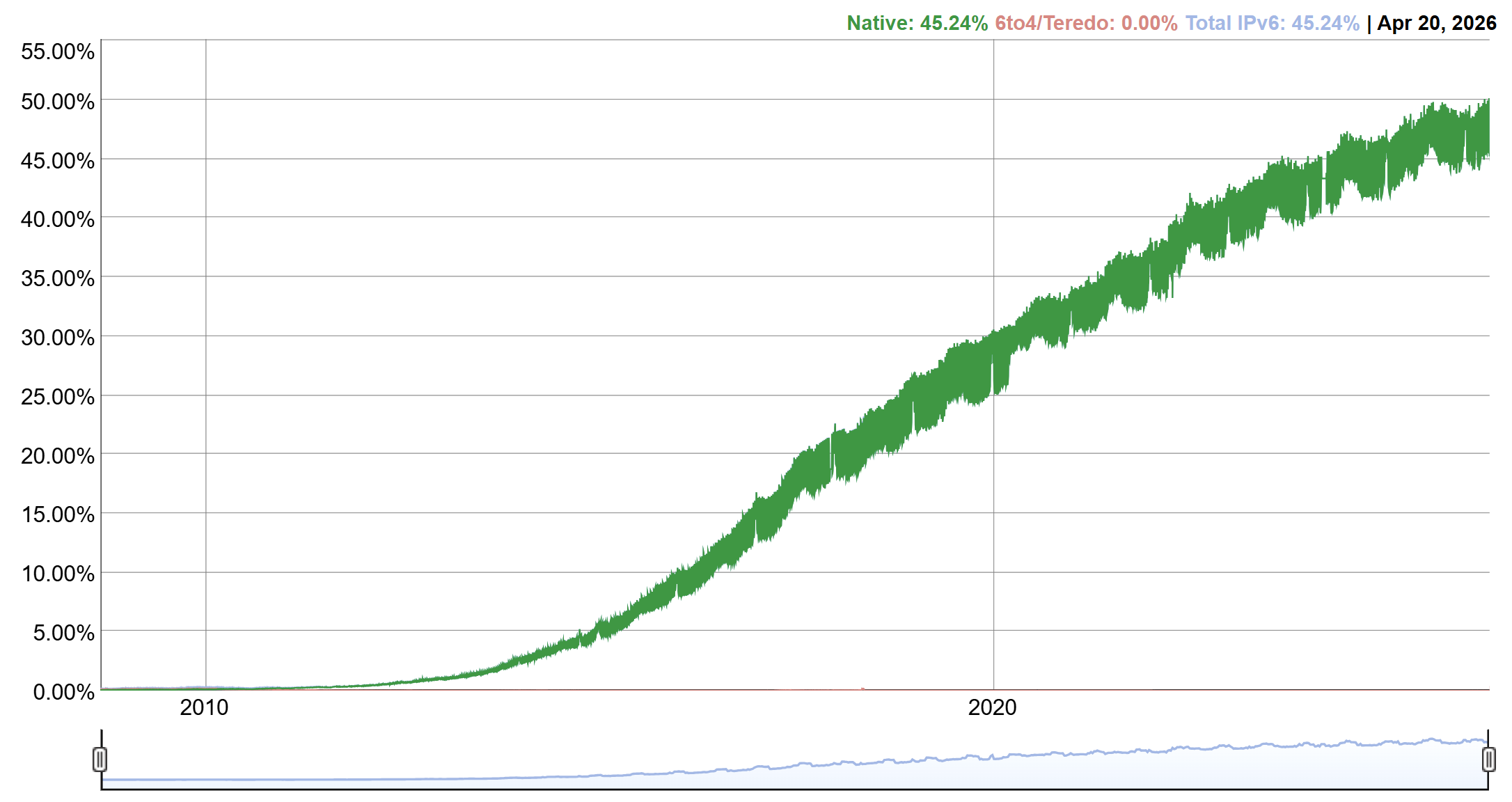
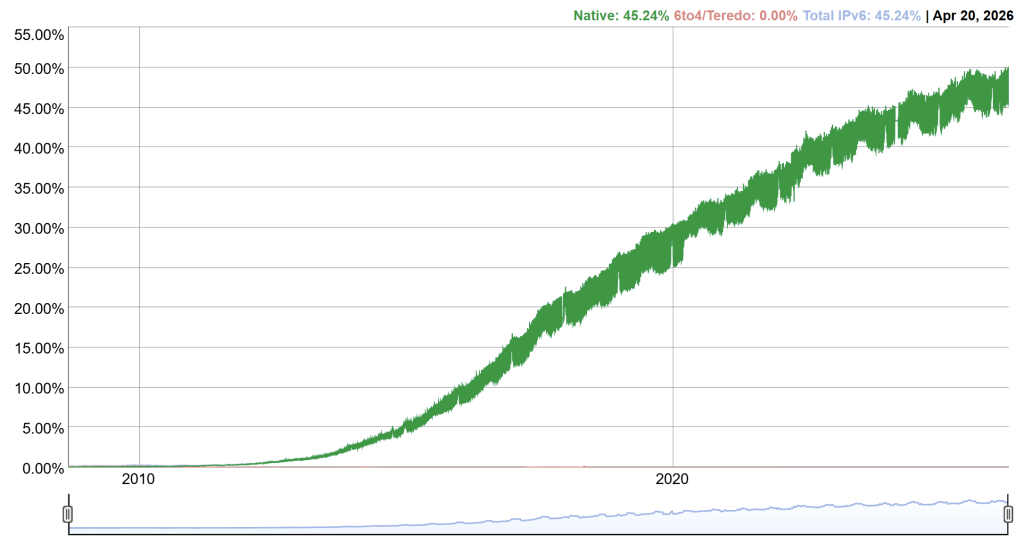
Figure 1 — Google’s global IPv6 adoption graph, as at 23 April 2026. Source.
The shape of IPv6 adoption isn’t evenly distributed
The global uptake of IPv6 follows a complex and varied path that isn’t apparent in a single, aggregated trend line. Google does not publish per‑region IPv6 statistics, and its per‑economy data is limited to overall totals, so these nuances are hard to see in Google’s figures alone. To understand how adoption really unfolds, it’s more instructive to look at the APNIC Labs data. Individual economies such as India, Viet Nam, and Saudi Arabia exhibit adoption curves that differ markedly from the global average. As the APNIC Labs data shows, this global trend does not necessarily reflect the experience of individual economies.
APNIC’s own measurement records a 42% worldwide IPv6 capability (Figure 2). That’s a substantial difference, which also needs clarifying.
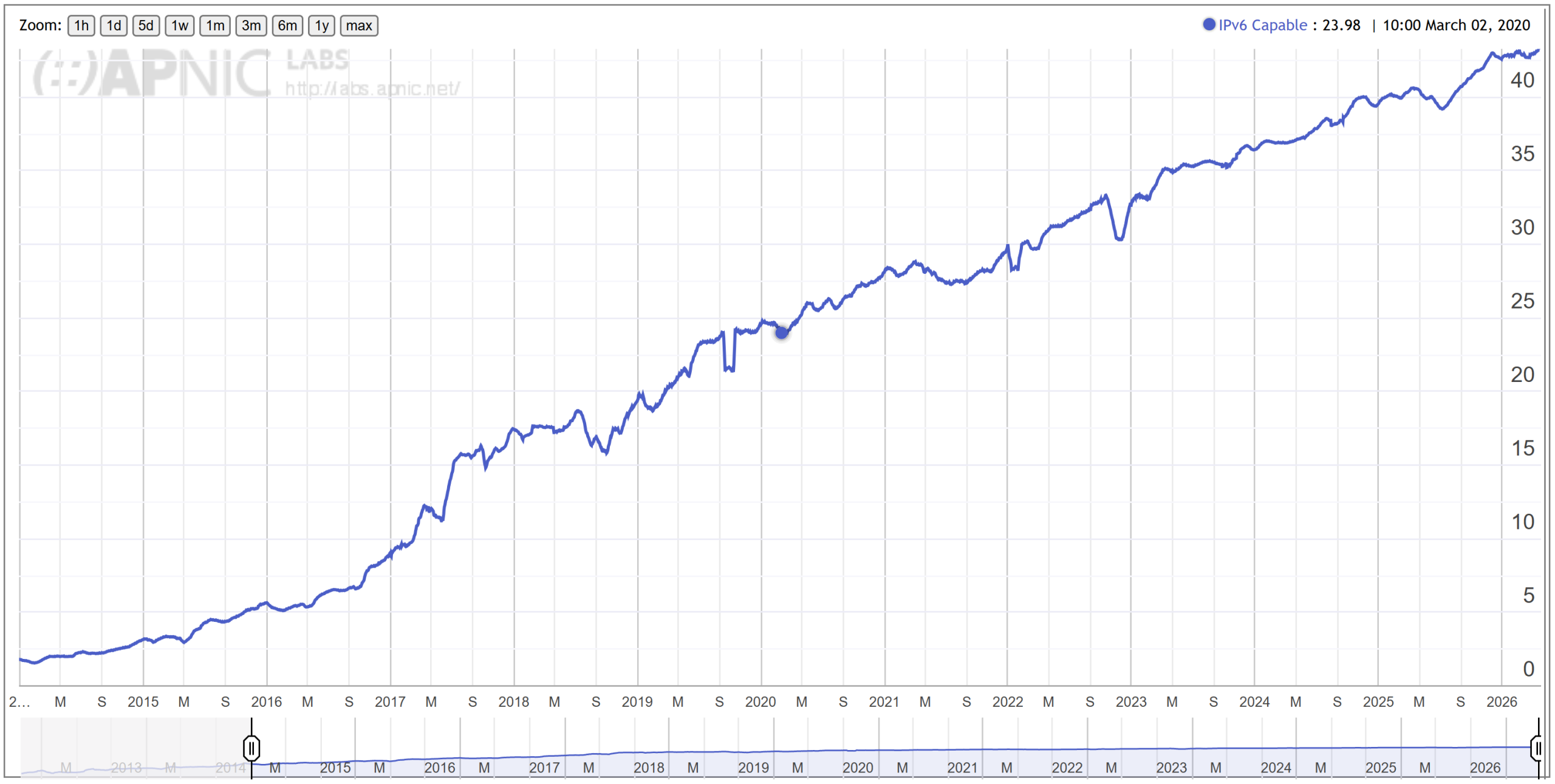
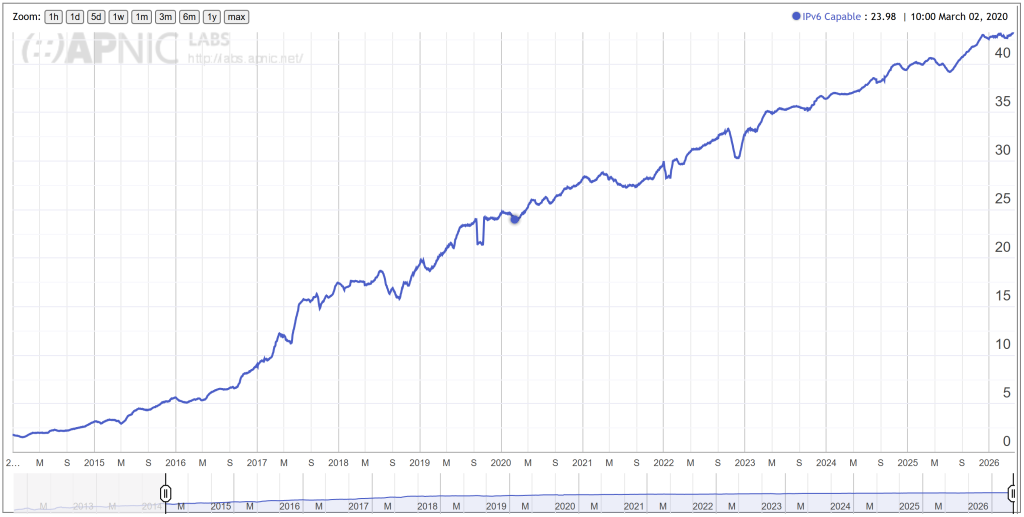
Figure 2 — APNIC Labs’ global IPv6 capability measurement, as at 23 April 2026. Source.
Measurement differences
APNIC’s measurement program is run by APNIC Labs and uses online advertising distributed through Google Ads, which appear in end users’ web browsers, games, and apps wherever Google advertisements are placed. APNIC does not select specific users and seeks the broadest possible exposure in every economy, 24/7. Normal advertising tracking systems are used with APNIC Labs logic, which ensures a unique set of tests are run, measuring IP, BGP routing and DNS, amongst other technology choices. No end-user Personally Identifiable Information (PII) data is held, and raw measurements are never shared, only collations at the ISP, economy and region level.
This work is carried out with the assistance of Google Research, ICANN, and others who help fund and support the activity. Given this close involvement, it’s natural to ask why APNIC’s measurement results don’t always align with Google’s own published statistics. If Google is used to conduct the research, how can the results differ?
APNIC’s measurement approach applies statistical weighting to the collected data and uses external sources, such as World Bank statistics, to model Internet usage by economy. This is necessary because the number of measurement samples APNIC Labs receives each day is not uniform. Advertising placements are optimized by Google to maximize delivery and revenue, which means that, on any given day, more advertisements, and therefore more measurement samples, may be shown in certain economies than others. For example, if advertising demand is higher in North African economies such as Egypt or Tunisia on a particular day, more measurements will be collected there, while fewer may be gathered from South America or Asia.
IPv6 capability reaches 50% in the Asia Pacific region
As a result, the raw sample counts cannot simply be aggregated to calculate global IPv6 capability. Instead, APNIC Labs aggregates the measured IPv6 capability for each economy and then weights it according to that economy’s estimated Internet user population.
In practice, this means that large Internet populations, such as those in India, China, Indonesia, and other major economies, contribute proportionally more to the global result than smaller economies, even if the raw sample volumes on a given day might suggest otherwise. This weighting ensures that the final measurements reflect global Internet usage more accurately, rather than daily advertising distribution patterns.
At the level of individual economies, APNIC Labs’ measurements generally align with the totals published by Google and with data from Cloudflare, Akamai, Cisco, and others. This suggests that the underlying measurements are comparable and that the larger differences observed at the global level are likely due to differences between APNIC’s weighting model. This may be why we see the large variances between the two measurements.
In practice, APNIC’s measurements tend to be lower than Google’s. As a result, it’s useful to view the two data sets together, as they effectively bracket the likely range of actual IPv6 capability at any given point in time.
Is IPv6 adoption progressing as expected?
Some point to the long path toward a 50% adoption milestone as evidence of a systemic failure in IPv6. Nothing could be further from the truth. Deploying IPv6 has required substantial technical effort and significant capital investment. It’s therefore entirely expected that progress has varied across regions and economies, as individual ISPs and economies make their own decisions about how best to balance network growth, user expectations, and the practical realities of operating Internet infrastructure.
The global Internet is not a ‘command economy‘, it evolves through collaboration and cooperation within market-driven conditions. Many providers made substantial capital investments in IPv4 in earlier periods and have naturally sought to maximize the return on those investments. In doing so, they built sustainable and commercially viable IPv4-based networks within their existing footprints.
By contrast, for newer market entrants, it has often been more rational to adopt IPv6 as the primary protocol, as it can demonstrably reduce the total cost of ownership. This pattern is particularly evident in the mobile sector, most notably in large-scale IPv6 deployments such as Reliance Jio’s network in India.
**Is the global Internet functioning in a ‘two‑protocol world’?**
Yes, but it could be simpler.
Certainly, it would be easier logistically to run a global internet under a single protocol. However, that is not the environment we have ended up with. Instead, the Internet today operates across a mix of direct IPv4 connectivity, IPv4 mediated through Network Address Translation (NAT), either in home networks or at the carrier level via Carrier‑Grade NAT (CGNAT), and IPv6.
Managing address translation through NAT is not materially less complex than alternatives such as protocol translation, IPv4 encapsulation over IPv6, or other transition and proxy mechanisms. As a result, claims that ‘IPv4 is working fine’ often overlook the underlying reality: Modern IPv4 networks already rely on layers of operational complexity, and there is no inherently lower‑cost or simpler approach available within IPv4 alone.
From the outset, it was understood that the lack of direct interoperability between IPv4 and IPv6 would be a challenge that needed to be addressed. Early efforts explored the idea of protocols that could subsume IPv4 unchanged and enable direct connectivity across both worlds, but these approaches did not prove viable.
Instead, interoperability has emerged at higher layers, with transport protocols such as TCP, UDP, and QUIC operating independently of the underlying IP version. This model necessarily relies on some form of intermediary. This is visible in the way large content and caching providers, such as Cloudflare, are able to offer dual‑stack services regardless of whether the backend systems themselves support both protocols.
The absence of native dual‑stack capability at some services, for example, certain Git platforms or national television broadcasters, is often perceived as a major barrier to IPv6 progress. However, this may reflect pragmatic constraints, such as operational complexity, or, in the case of national broadcasters, legal and regulatory requirements around data access and geolocation, rather than resistance.
Let’s recognize the 50% milestone, even as the journey continues
Whatever one’s view on the decision to introduce a second addressing and protocol model beneath today’s Internet services, the reality is clear: IPv6 is now deployed on a global scale. Around half of the Internet users visible to Google already reach its services over IPv6. IPv6 is used every day, every hour, across developed and developing economies alike, on fixed and mobile networks, on small personal devices, and within vast data‑centre‑backed services. It is no longer experimental or marginal; it is part of the Internet’s day‑to‑day operation.
That achievement reflects the collective effort of those working to build, operate, and grow the Internet worldwide, and it is something worth recognizing and taking pride in.
The views expressed by the authors of this blog are their own and do not necessarily reflect the views of APNIC. Please note a Code of Conduct applies to this blog.
3 Comments
1. **Named Bird**April 29, 2026 at 1:05 am Yes, the 50% milestone is very nice, even if it doesn’t change anything on a technical level. It’s a good argument to use when arguing why people need IPv6 though. Perhaps it makes my ISP take it a bit more serious. !Image 10: 😉

Here’s my current IPv6 issue checklist:
– Google/Firefox think that IPv6-only websites do not exist if you’re on IPv4.
– Most speedtests and uptime checkers just ignore or misreport for IPv6.
– Linux kernel cannot be compiled with IPv4 without also including IPv4
– Many ISP’s still don’t have timelines for IPv6 deployment
– You would expect most popular websites to have deployed IPv6 by now, especially Github. (They have not!)
– Many IT studies still don’t (fully) cover IPv6 in class.
If even half of these items would be done, it would majorly speed up IPv6 deployment…
Reply↓ 2. **Paul L**April 29, 2026 at 5:14 am Despite the differences both graphs show a trend that can be modelled to good approximation as a linear growth in adoption since 2018.
The slope of that trend is also similar for both graphs where 10% per 3 years provides a good fit.
The highest per-annum growth was around 5% (10% every 2 years) if you treat the initial uptake curve as 2012-2018.
This means that by 2030 it will be clear if linearity continues or if/when the industry or regions are tacking more entrenched systems.
Reply↓ 3. **Jordi Palet**April 30, 2026 at 8:10 pm I think it is worth to mention that the Google stats don’t measure China adoption, which clearly accounts for a big % of the Internet, and is progressing very fast. If google could measure that, probably we will discover that in reality we are pass the 65-75%.
Also we need to understand that the bigger content providers and CDNs (Meta, Google, Akamai, etc.), have deployed IPv6 and their traffic usually accounts for the biggest chunk of the total Internet traffic. In addition to that, because those content providers and CDNs have caches everywhere, measurements in IXs (for example), only can measure once a video, update or whatever, which is downloaded by ISP customers many times. So a more ISPs are deploying IPv6, the effect of real IPv6 traffic to the edge is much bigger than what we are actually able to measure and verify.
Leave a Reply Cancel reply
Your email address will not be published.Required fields are marked *
Comment *
Name *
Email *
- [x] Save my name and email in this browser for the next time I comment.
- [x] Yes, add me to your mailing list
- [x] Notify me of follow-up comments via email. You can also subscribe without commenting.
Δ
Get Updates
Please leave this field empty
Email *
Show options
Select list(s):- [x] Daily - [x] Weekly
Thanks for subscribing! Check your inbox or spam folder to confirm your subscription.
Authors
- Adli Wahid
- Aftab Siddiqui
- Geoff Huston
- George Michaelson
- Jen Linkova
- Jia Rong Low
- Job Snijders
- Kathleen Moriarty
- Premanand Seralathan
- Ulrich Speidel
- A Khalil Azizi
- A S M Rizvi
- AbdelRahman Abdou
- Abhishek Jain
- Abu Sufian
- Achie Atienza
- Adam Gosling
- Adam McFillin
- Adam Oest
- Adeel Sadiq
- Adiel Akplogan
- Adisorn Lertsinsrubtavee
- Adli Wahid
- Adrian Farrel
- Adrian Wan
- Afifa Abbas
- Afsheen Saadat
- Aftab Siddiqui
- Agustín Formoso
- Ahmad Darki
- Ajay Kumar
- Akimichi Ogawa
- Alain Aina
- Alan DeKok
- Alan Mauldin
- Albert Gran Alcoz
- Alden Hilton
- Alec Muffett
- Alejandro Acosta
- Alex Band
- Alex Boten
- Alex Turing
- Alex Yen
- Alexander Azimov
- Alexander Kozlov
- Alfred Arouna
- Ali Abedi
- Ali Norouzi
- Amanda H A Watson
- Amaury Van Bemten
- Amreesh Phokeer
- Amrita Choudhury
- Anand Buddhdev
- Anant Shah
- Andra Lutu
- Andre Gelderblom
- Andrea Sordello
- Andreas Dewes
- Andreas Reuter
- Andree Toonk
- Andrei Robachevsky
- Andrew Ayer
- Andrew Campling
- Andrew Cormack
- Andrew Cushen
- Andrew Ferguson
- Andrew Gray
- Andrew Sullivan
- Andrew Toimoana
- Andrijana Todosijević
- Andy Mindnich
- Andy Newton
- Anju Mangal
- Anna Maria Mandalari
- Annaliza Mulingbayan
- Anosh Khan
- Anriette Esterhuysen
- Anthony Lee
- Anton Strydom
- Anup Changaroth
- Anurag Bhatia
- APNIC
- Apoorv Shukla
- Arash Molavi Kakhki
- Arian Niaki
- Aris Tzermias
- Arjuna Sathiaseelan
- Arlin Kokkelmans
- Arth Paulite
- Arthur Gilly
- Artyom Gavrichenkov
- Arun Neelicattu
- Asad Ali
- Asanka Sayakkara
- Ashil Oogarah
- Ashwin Kumar
- Ashwin Rangan
- Athina Fragkouli
- Audrey Randall
- Aurélien Aptel
- Austin Hounsel
- Austin Ruckstuhl
- Avery Pennarun
- Ayesha Iftikhar
- Aysha Labiba
- Ayush Mishra
- Azfar Adib
- Azhar Khuwaja
- Azura Mat Salim
- Baojun Liu
- Baptiste Jonglez
- Barbara Jantzen
- Barry Greene
- Bart Hogeveen
- Basileal Imana
- Bastian Kanbach
- Batmagnai Erdene
- Bayar Batjargal
- Beau Gieskens
- Ben Cox
- Ben Du
- Ben Schwartz
- Benjz Gerard Sevilla
- Benno Overeinder
- Berislav Todorovic
- Bert Hubert
- Bhadrika Magan
- Bhumika Sapkota
- Bikram Shrestha
- Bill Hess
- Bill Stearns
- Bill Woodcock
- Bjørn Teigen
- Blake Anderson
- Blandine Cousin
- Blas Trigueros
- Branden Palacio
- Brandon Hitzel
- Brenda Buwu
- Brenden Kuerbis
- Brent Carey
- Brett Bralley
- Brian Carpenter
- Brian Nisbet
- Brian Trammell
- Brianna Boudreau
- Bruce Davie
- Bruce Spang
- Byambajargal Jamsran
- Byron Ellacott
- Byungjin Jun
- Cameron Steel
- Carlos Martinez-Cagnazzo
- Carsten Strotmann
- Caspar Schutijser
- Cecilia Testart
- Cengiz Alaettinoglu
- CF Chui
- Champika Wijayatunga
- Charith Amarasinghe
- Che-Hoo Cheng
- Cheeyong Tay
- Cherie Lagakali
- Chia Ling (Jolin) Chan
- Chika Yoshimura
- Ching-Heng Ku
- Chris Amin
- Chris Buckridge
- Chris Grundemann
- Chris Parker
- Chris Ritzo
- Chris Siebenmann
- Christian Giese
- Christian Huitema
- Christoph Dietzel
- Christopher Hawker
- Chuan Jiang
- Ciprian Popoviciu
- Clarence Filsfils
- Claudio Jeker
- Clemens Mosig
- Colin Perkins
- Constance Bommelaer
- Constantin Sander
- Constanze Dietrich
- Cordian Daniluk
- Craig Miller
- Craig Ng
- Craig Rowland
- Dale Roberts
- Dan Fidler
- Dan Groshev
- Dan Li
- Daniel Dib
- Daniel Kopp
- Danilo Giordano
- Danny Alex Lachos Perez
- Danny Pinto
- Daryll Swer
- Dashzeveg Baatartsogt
- Dave Mill
- Dave Phelan
- David Anderson
- David Burkett
- David Dawson
- David Holder
- David Holsgrove
- David Huberman
- Dean Pemberton
- Debashis Pal
- Debopam Bhattacherjee
- Deepak Vasisht
- Denesh Bhabuta
- Dennis Baaten
- Désirée Miloshevic
- Dewangga Alam
- Dewole Ajao
- Dhruv Dhody
- Di Ma
- Diego Pino García
- Dinesh Bhatia
- Diptanshu Singh
- Dirk Doesburg
- Dirk Trossen
- Dmytro Shypovalov
- Donatas Abraitis
- Donika Mirdita
- Doug Madory
- Doug Montgomery
- Dr Bahaa Al-Musawi
- Dr Govind
- Drikus Brits
- Duane Wessels
- Duncan Macintosh
- E. Marie Brierley
- Ebrima Jaw
- Ed Horley
- Edward Lewis
- Edwin Sandys
- Ege Cem Kirci
- Eline Stehouwer
- Eliot Lear
- Elizabeth Krumbach Joseph
- Ellisha Heppner
- Elly Tawhai
- Elvin Prasad
- Emile Aben
- Emily Gallarde
- Emily Stark
- Emir Beganović
- Eneken Tikk
- Enno Rey
- Enric Pujol
- Eric Lawrence
- Eric Loos
- Eric Vyncke
- Erik Hjelmvik
- Erik Rye
- Erin Scherer
- Eshaan Bansal
- Esteban Carisimo
- Eugene Bogomazov
- Eunju Kang
- Eunju Pak
- Eyal Estrin
- Fabián Bustamante
- Fahad Hilal
- Fakrul Alam
- Farbod Shahinfar
- Farha Diba
- Fenglu Zhang
- Ferenc Fejes
- Fernando Gont
- Flavia Salutari
- Flavio Luciani
- Florentin Rochet
- Florian Holzbauer
- Florian Steurer
- Florian Streibelt
- Foy Shiver
- Francesco Ferreri
- Francesco Sassi
- Franck Martin
- François Michel
- Frane Maroevic
- Frank Denis
- Frank Herberg
- Franziska Lichtblau
- Fred Christopher
- Fred Templin
- Fredrik Lindeberg
- Ganga R Dhungyel
- Gaurab Raj Upadhaya
- Gautam Akiwate
- Gavin Reid
- Gavin Tweedie
- Geoff Huston
- George Kuo
- George Michaelson
- George Odagi
- George Sadowsky
- George Salisbury
- Giacomo Giuliari
- Gianmarco Pagani
- Gina Mahe
- Giovane Moura
- Gomer Padong
- Gonchig Altansukh
- Gordon King
- Greg Ferro
- Greg Hankins
- Grégory Mounier
- Guangliang Pan
- Guillermo Baltra
- Guoliang Yang
- GZ Kabir
- Ha Dao
- Haisheng Yu
- Hammas Bin Tanveer
- Han Zhang
- Hanna Kreitem
- Hannah Durack
- Hanno Böck
- Hans Petter Holen
- Harish Chowdhary
- Haya Schulmann
- Helen Hollins
- Herbert Wolverson
- Hervé Clément
- Hideyuki Sasaki
- Hinne Hettema
- Hiroki Kawabata
- Hiroko Kamata
- Hiromu Shiozawa
- Hisham Ibrahim
- Hoàng Nguyên Phong
- Holly Bergen
- Houlin Zhao
- Hyeonmin Lee
- Hyojoon Kim
- Ignacio Castro
- Ihita Gangavarpu
- Ike Kunze
- Ilker Nadi Bozkurt
- Imtiaz Rahman
- Indya Bolton
- Ioana Livadariu
- Italo Cunha
- Ivan Ristić
- Ivana Tomic
- Ivo A. Ivanov
- Ivy Yip
- Izumi Okutani
- Jaber Daneshamooz
- Jaclyn Knight
- Jacob Davis
- Jacob Ginesin
- Jahangir Hossain
- Jake Bauer
- Jake Flint
- Jake Holland
- James Ah Wai
- James Bensley
- James Kettle
- James Pavur
- James Richards
- James Shank
- Jamie Gillespie
- Jan Doskočil
- Jan Harm Kuipers
- Jan Rüth
- Jan Schaumann
- Jan Zorz
- Jan-Piet Mens
- Jane Yen
- Jannik Peters
- Jari Arkko
- Jason Livingood
- Jason Smith
- Jasper den Hertog
- Jawad Ahmed
- Jay Daley
- Jay Ford
- Jeff Chan
- Jeff Fry
- Jeff Man
- Jeff Osborn
- Jen Linkova
- Jenine Beekhuyzen
- Jens Link
- Jeremy Harrison
- Jerry Lundström
- Jessica Shen
- Jessica Wei
- Jethro Webston
- Jia Rong Low
- Jilong Wang
- Jim Cowie
- Jim Forster
- Jim Vella
- Jimmy Lim
- Jing Qiao
- Jinghua Bai
- Jinwei Zhao
- Joanna Kulesza
- João L. Sobrinho
- Joao Luis Silva Damas
- Joao M. Ceron
- Job Snijders
- Joel Jaeggli
- Johanna Amann
- Johannes Krupp
- Johannes Weber
- Johannes Zirngibl
- John Althouse
- John Bambenek
- John Curran
- John Garrity
- John Jack
- John Jason Brzozowski
- John Kristoff
- John Scudder
- John Welborn
- Jonas Mücke
- Jonathan Brewer
- Jonathan Magnusson
- Jordan Carter
- Jordan Jueckstock
- Jordi Paillissé
- Jordi Palet Martinez
- Josef Gustafsson
- Joseph Salowey
- Joy Chan
- Joyce Chen
- Joyeeta Sen Rimpee
- Juan Ramón Santana
- Juha Saarinen
- Julia Evans
- Julián Martín Del Fiore
- Julien Gamba
- Jun Murai
- Justin Loye
- Justin Ryburn
- Justin Wilson
- Kaajal Kumar
- Kaan Onarlioglu
- Kanagaraj Krishna
- Karan Sharma
- Karel Hynek
- Karl Lovink
- Karla Skarda
- Kasek Galgal
- Kashyap Thimmaraju
- Katherine Izhikevich
- Kathleen Moriarty
- Katsuyasu Toyama
- Kavya Bhat
- Kazunori Fujiwara
- Ke Ma
- Keisuke Kamata
- Kemal Sanjta
- Kenjiro Cho
- Kenny Huang
- Kenrick Lin
- Kensuke Fukuda
- Kevin Backhouse
- Kevin Bock
- Kevin Jin
- Kevin Ku
- Kevin Meynell
- Kevin Vermeulen
- Kevon Swift
- Keyu Man
- Khee Hong Loke
- Khwaja Zubair Sediqi
- Kijush Maharjan
- Kiruthika Devaraj
- Klée Aiken
- Kobayashi Masayuki
- Koen van Hove
- Koichi Kunitake
- Koki Nakagawa
- Konrad Wolsing
- Korian Edeline
- Kostas Zorbadelos
- Kris Shrishak
- Kurt Lindqvist
- Kyle Carter
- Kyle Drake
- Kyle Schomp
- Lan Wei
- Lari Huttunen
- Lars Prehn
- Lars-Johan Liman
- Leandro Bertholdo
- Leandro Navarro
- Lee Howard
- Leigh Metcalf
- Lenore Zuck
- Leo Vegoda
- Leonid Todorov
- Leslie Daigle
- Lia Hestina
- Liang Wang
- Liang Zhao
- Liangcheng Yu
- Libin Liu
- Lindsay Graham
- Linjian Song
- Lisa Bruder
- Lisa Corness
- Lisandro Ubiedo
- Lixin Liu
- Liz Izhikevich
- Loba Olopade
- Lorenzo Cogotti
- Louise Tromp
- Lu Zhang
- Luca Sani
- Lucas Pardue
- Luke Thompson
- Luuk Hendriks
- Lyubomir Yanev
- M. Yasir M. Haq
- Maarten Botterman
- Maarten Wullink
- Maciej Korczyński
- Madeline Carr
- Maemura Akinori
- Mai Thu Thuy
- Mailelatamai Halatuituia
- Major Hayden
- Makito Lay
- Mallory Knodel
- Manaf Gharaibeh
- Mannat Kaur
- Mansour Ganji
- Marc Bruyere
- Marcin Nawrocki
- Marco Chiesa
- Marco Cilloni
- Marco Hogewoning
- Marcus Brinkmann
- Marcus Keane
- Marek Majkowski
- Maria Namestnikova
- Maria Theresa Perez
- Mariano Scazzariello
- Mariko Kobayashi
- Marilyn Zhang
- Mario Loffredo
- Mark Andrews
- Mark Karpilovskij
- Mark Nottingham
- Mark Prior
- Mark Smith
- Mark Tinka
- Markus Dahlmanns
- Markus Legner
- Markus Sosnowski
- Marta Burocchi
- Marten Porte
- Martin Hannigan
- Martin Hoffmann
- Martin Langer
- Martin Pedram
- Martin Thomson
- Martin Winter
- Martino Trevisan
- Mary Hogan
- Mary Rose Ofianga-Rontal
- Masanori Yajima
- Masataka Mawatari
- Massimo Candela
- Mat Ford
- Matsuzaki Yoshinobu
- Matt Larson
- Matt Oh
- Matt Palmer
- Matt Ringel
- Matt Stith
- Matthew James
- Matthew Thomas
- Matthias Wichtlhuber
- Matthijs Mekking
- Mattijs Jonker
- Max von Hippel
- Maxime Mouchet
- Maxime Piraux
- Maynard Koch
- Md Abdul Awal
- Md Mahedi Hasan
- Md Main Uddin Hasan
- Md. Kamruzzaman Khan
- Megan Baker
- Melchior Aelmans
- Melody Bendindang
- Merike Kaeo
- Metin Açıkalın
- Michael Clare
- Michael Kende
- Michael Patterson
- Michael Rabinovich
- Michael Schapira
- Michael Schneider
- Michael Waidner
- Michelle Thorne
- Mika Kerttunen
- Mike Hollyman
- Mike Hwang
- Mike Kosek
- Min Sung Jung
- Mingming Zhang
- Mingwei Zhang
- Mingxuan Liu
- Minzhao Lyu
- Miwa Fujii
- Mohamad Dikshie Fauzie
- Mohamed Awnallah
- Mohamed Boucadair
- Mohamed Kassem
- Mohammad Larosh Khan
- Molay Ghosh
- Momoka Yamamoto
- Moritz Müller
- Mubashir Sargana
- Muhammad Moinur Rahman
- Muhammad Yasir Shamim
- Mujtaba Hussain
- Mukhammad Andri Setiawan
- Munkhbat Gansukh
- Muzamer Mohd Azalan
- Nachiket Kondhalkar
- Nadir Hassan
- Nafeez Islam
- Nalini Elkins
- Narayan G
- Narelle Clark
- Natale Bianchi
- Nate Sales
- Nathalie Romo Moreno
- Nathalie Trenaman
- Neeti Biyani
- Neta Rozen Schiff
- Nick Buraglio
- Nick Hilliard
- Nick Janetakis
- Nick Nugent
- Nico Schottelius
- Nicola Rustignoli
- Nicole Wajer
- Niels Provos
- Nihit Tandon
- Niklas Vogel
- Nikolai Hampton
- Nikos Kostopoulos
- Nils Wisiol
- Nina Bargisen
- Nirav Atre
- Nooshin Eghbal
- Nor Fadzilah Abdullah
- Nowmay Opalinski
- Nurul Islam Roman
- Nusenu
- Nyamkhand Buluukhuu
- Oanh Nguyen
- Oky Tria Saputra
- Ólafur Guðmundsson
- Olamide Omolola
- Oliver Gasser
- Oliver Michel
- Olivier Hureau
- Olivier Tilmans
- Omar Alrawi
- Omar Ansari
- Ondřej Caletka
- Ondřej Surý
- Otto Moerbeek
- Pablo Hinojosa
- Paolo Lucente
- Paresh Khatri
- Parkpoom Tripatana
- Pasan Lamahewa
- Pascal Huppert
- Patrick McManus
- Patrick Sattler
- Patrik Fältström
- Paul Dale
- Paul Grubbs
- Paul Wilson
- Pavel Odintsov
- Pawel Kowalik
- Paweł Foremski
- Paweł Urbanek
- Pedro Marcos
- Pengxiong Zhu
- Pete Sclafani
- Pete Stevens
- Peter Blee
- Peter Hansteen
- Peter Lowe
- Peter Maynard
- Peter Peele
- Petr Špaček
- Petros Gigis
- Phil Lavin
- Phil Mawson
- Philip Homburg
- Philip Paeps
- Philip Smith
- Philipp Jeitner
- Philipp Richter
- Pier Carlo Chiodi
- Pim van Pelt
- Piotr Kijewski
- Platon Kotzias
- Pouyan Fotouhi Tehrani
- Prakriti Timilsina
- Pranav Kondala
- Praneet Kaur
- Premanand Seralathan
- Pubudu Jayasinghe
- Qasim Lone
- Quincy Liao
- Rachee Singh
- Rafael Cintra
- Raffaele Sommese
- Raffaele Zullo
- Rahul Makhija
- Rajnesh Singh
- Ralph Dolmans
- Ralph Holz
- Ram Sundara Raman
- Ramakrishna Padmanabhan
- Rami Al-Dalky
- Ramin Yazdani
- Ran Ben Basat
- Ranysha Ware
- Raphael Hiesgen
- Raquel Gomez
- Raquel Rugani Lage
- Raskia Nayanajith
- Ray Bellis
- Rebekah Houser
- Remi Gacogne
- Rene Bakker
- René Wilhelm
- Renée Burton
- Richard Cziva
- Richard Jimmerson
- Richard Nelson
- Richard Patterson
- Richard Read
- Rick McElroy
- Rishabh Chhabra
- Rob Schult
- Robbie Mitchell
- Robert Alexander
- Robert Kisteleki
- Robin Marx
- Roderick Fanou
- Roger Meyer
- Rohana Palliyaguru
- Roland Meier
- Roland van Rijswijk-Deij
- Rolf Winter
- Romain Fontugne
- Ron Bonica
- Ron Winward
- Ronald van Kleunen
- Rowena Schoo
- Roy Arends
- Rüdiger Birkner
- Russ White
- Ryan Beckett
- Ryan Gerstenkorn
- Ryo Nakamura
- Sachin Ashok
- Safiqul Islam
- Said Jawad Saidi
- Said Zazai
- Saima Nisar
- Sajidur Rahman Rabby
- Salvatore Cuzzilla
- Sam Sham
- Samaneh Tajalizadehkhoob
- Samantha Douglas
- Samantha Frank
- Samit Jana
- Samuel Steffen
- Sandra Davey
- Sandra Siby
- Sangeetha Abdu Jyothi
- Sanjaya
- Sara Dickinson
- Sarah Escandor-Tomas
- Sarah McAree
- Sarmad Hussain
- Sarvesh Mathi
- Sasha Romijn
- Satadal Sengupta
- Satoru Matsushima
- Satoru Tsurumaki
- Sayda Kamrun Jahan Ripa
- Scott Hollenbeck
- Scott Shenker
- Sebastian Castro
- Sebastian Neef
- Sebastian Zander
- Sebastien Meriot
- Seiichi Kawamura
- Seluvaia Kauvaka
- Seth Schoen
- Shah Sahari
- Shahee Mirza
- Shahzeb Mustafa
- Shamim Reza
- Shamsullah Shams
- Shane Alcock
- Shane Kerr
- Sharada Yeluri
- Sharat Chandra Madanapalli
- Shayan Azizi
- Sheetal Kumar
- Sheikh Md Seum
- Shermaine Yung
- Sherry Shek
- Sheryl Hermoso
- Shian-Shyong Tseng
- Shinoj Pittandavida
- Shishio Tsuchiya
- Shivan Sahib
- Shoko Nakai
- Shu Hao Tung
- Shuai Hao
- Shucheng Liu
- Shumon Huque
- Shusei Tomonaga
- Shyam Krishna Khadka
- Siena Perry
- Simon Baroi
- Simon Bauer
- Simran Patil
- Siva Kesava
- Sivaram Ramanathan
- Sofia Silva Berenguer
- Sonam Keba
- Song Bing
- Spiros Thanasoulas
- Srikanth Sundaresan
- Srimal Andrahennadi
- Stanley Osao
- Stefan Mehner
- Stefan Ubbink
- Stefano Servillo
- Steinthor Bjarnason
- Stephan Marwedel
- Stéphane Bortzmeyer
- Stephen McQuistin
- Stephen Ryan
- Stephen Strowes
- Steve Crocker
- Steve Santorelli
- Stijn Pletinckx
- Subha Shamarukh
- Subhashini Kadurugasyaya
- Sue Graves
- Suetena Faatuuala Loia
- Suksit Sripitchayaphan
- Sunny Chendi
- Suresh Krishnan
- Susan Forney
- Suvam Basak
- Svaradiva Devi
- Swapneel Patnekar
- Swaran Ravindra
- Sylvain Cortes
- Sylvia Cadena
- Szymon Trocha
- Taejoong Chung
- Taiji Kimura
- Talha Paracha
- Tan Kean Siong
- Tan Tin Wee
- Tanya Shreedhar
- Tashi Phuntsho
- Teav Sovandara
- Temitope Lawal
- Terry Sweetser
- Teun Vink
- Thein Myint Khine
- Theo Jepsen
- Theophilus A. Benson
- Thijs van den Hout
- Thomas Holterbach
- Thomas King
- Thomas Koch
- Thomas Krenc
- Thomas Liske
- Thomas Millar
- Thomas Patzke
- Thomas Scheffler
- Thomas Wirtgen
- Thy Boskovic
- Thymen Wabeke
- Tianxiang Dai
- Tim Bruijnzeels
- Tim Chown
- Tim Fiola
- Tim Raphael
- Timm Böttger
- Timo Longin
- Timothy Hildred
- Timothy Winters
- Tiong Beng Ng
- Tobias Fiebig
- Todd Arnold
- Tom Barbette
- Tom Carpay
- Tom Coffeen
- Tom Do
- Tom Harrison
- Tom Hollingsworth
- Tom Křížek
- Tom Perrine
- Tomek Mrugalski
- Tommaso Caiazzi
- Tomoaki Tani
- Tony Finch
- Tony Li
- Tony Scheid
- Tony Smith
- Tony Tauber
- Torsten Zimmermann
- Trinh Viet Doan
- Truong Khanh Huyen
- Tuan Nguyen
- Tugsorshikh Badarch
- Tushar Swamy
- Ulafala Viliamu
- Ulrich Hauser
- Ulrich Speidel
- Usama Naseer
- Uta Meier-Hahn
- Vanessa Maria Fernandes
- Vashkar Bhattacharjee
- Vasileios Giotsas
- Vasileios Kotronis
- Vasilis Chryssos
- Venkat Arun
- Veronika McKillop
- Vesna Manojlovic
- Vicky Risk
- Vijay Sivaraman
- Vijay Varadharajan
- Viktor Dukhovni
- Vinay Kumar
- Vincent Bernat
- Vincentas Grinius
- Vitaly Kamluk
- Vittorio Bertola
- Vivek Nigam
- Vivien Maidaborn
- W K Shiu
- Wang Hao
- Wanqing Tu
- Warren Finch
- Warren Kumari
- Wassie Goushe
- Wataru Ohgai
- Wayne Thayer
- Wen-Tsung Chang
- Werachart Muttitanon
- Wes Hardaker
- Wilaiwan Phanarin
- Wilhelm Boeddinghaus
- Willem Toorop
- William Lu
- Willy Sutrisno
- Winfried Tilanus
- Wita Laksono
- Wout de Natris
- Wouter de Vries
- Xiang Li
- Xiao Zhang
- Xiaohong Deng
- Xiaoqi Chen
- Xing Li
- Xinlei Yang
- Xuewei Feng
- Yali Liu
- Yeo Lee Chin
- Yevheniya Nosyk
- Yi Cao
- Yihao Chen
- Yiming Zhang
- Ying Tian
- Ying-Chu Chen
- Yoshibumi Suematsu
- Yoshinori Takesako
- Yoshitaka Aharen
- Younghwan Choi
- Yuedong Zhang
- Yunfei Ma
- Yurie Ito
- Yury Zhauniarovich
- Yuta Takata
- Yuxiang Yang
- Zachary Bischof
- Zaid Ali Kahn
- Zaifeng Zhang
- Zain Shamsi
- Zen Ng
- Zeqi Lai
- Zhenyu Li
- Zhiyi Chen
- Zili Meng
- Zinan Lin
- Zolzaya Shagdar
Show All (1009)Show Pinned (10)
Tags
- APNIC Foundation
- APNIC Training
- Australia
- BGP
- capacity development
- CERTs
- China
- DNS
- DNSSEC
- Event Wrap
- Guest Post
- How to
- IANA
- ICANN
- IETF
- IGF
- India
- Indonesia
- Internet Governance
- IPv4
- IPv6
- ISIF Asia
- ITU
- IXPs
- Japan
- measurement
- networking
- NOGs
- NRO
- opinion
- Pacific
- peering
- podcast
- Policy
- RIPE NCC
- RIRs
- ROAs
- routing
- RPKI
- security
- TCP
- Three of the best
- TLS
- tools
- Whois
Related Articles
-  by Karla Skarda April 11, 2024 On 29 February 2024, APNIC welcomed its 10,000th Member.
-  by Terry Sweetser April 3, 2026 Guest Post: How a modern SOHO network can achieve an 80% native IPv6 ratio by leveraging NetFlow insights to identify residual IPv4 paths and eliminate them.
-  by Dan Fidler August 13, 2025 Mid-2025 data shows sustained IPv6 growth in China, backed by coordinated policy, infrastructure upgrades, and rising application-level adoption.
-  by Daryll Swer May 19, 2025 How to set up native routed IPv6 in Docker with routed mode.


Connect with us
© 2026 APNIC ABN 42 081 528 010
